
Apollo vs Instantly for Indian startups: which to pay for first in 2026
Short answer: if you have no list, pay for Apollo first (Basic is $49 per user per month on the page's own offer data; the free plan is enough to test). If you have a list and no safe way to send to it, pay for Instantly first (Growth is $37.60 a month billed annually or $47 monthly, with unlimited warmup and unlimited connected mailboxes). Most Indian startups past their first ten customers end up paying for both, because Apollo's sending is capped per mailbox and Instantly's lead data is thinner than a dedicated database. That two-tool stack, with sending domains kept separate from the company domain and two to three weeks of warmup, is what Digital Patron runs for clients from Gurugram and Mohali.
Disclosure: Digital Patron is an Instantly partner and uses both tools in client work; we are not paid by Apollo. Prices below were read from apollo.io/pricing and instantly.ai/pricing on 14 October 2026 and are quoted as the pages show them, with billing terms. Where a page would not render a figure to our check, we say so. Sources are at the end.
What each tool actually is
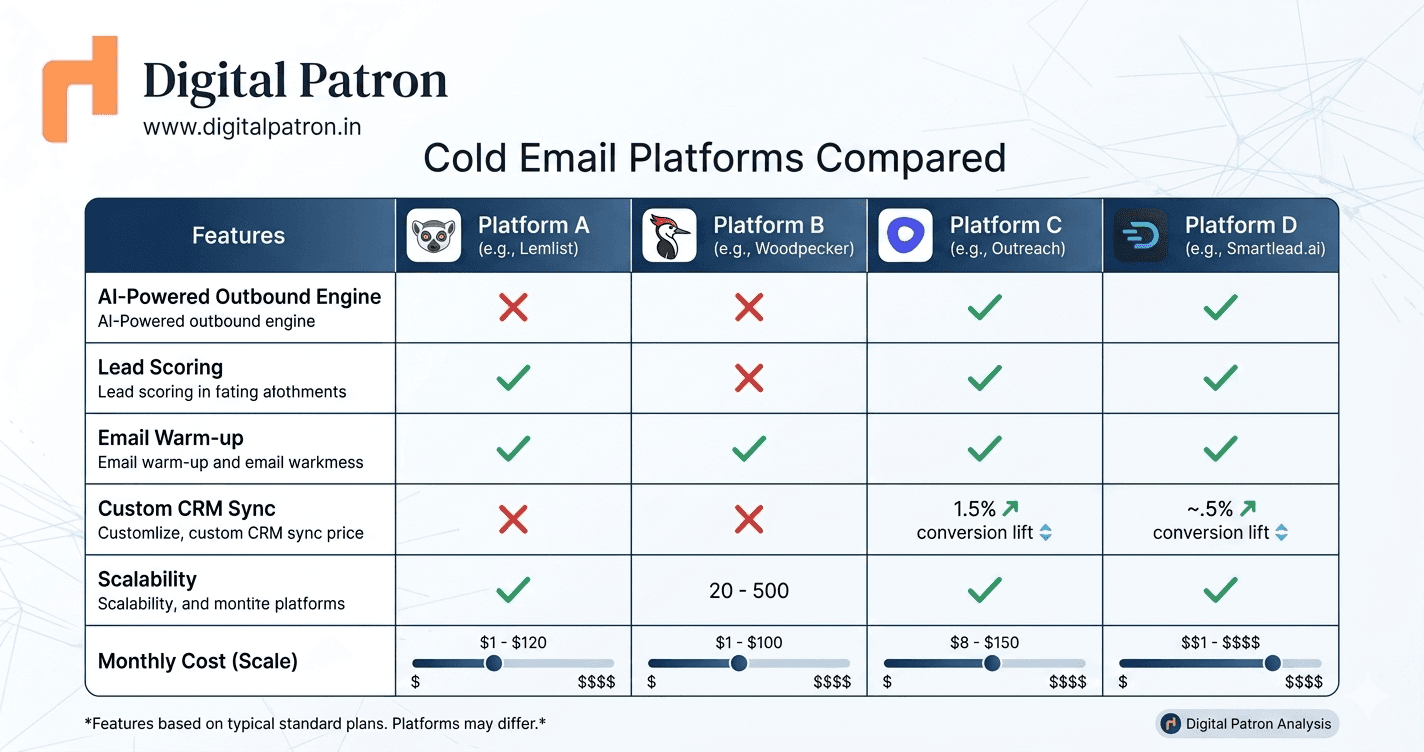
Apollo is a B2B contact and company database with a sequencer, a dialler and CRM sync attached. Its value is that you can search for a persona and be in a sequence without a second vendor. Its weakness for cold email is the sending layer: volume is capped per connected mailbox, there is no deep inbox rotation, and native warmup was retired in 2024, so warmup now runs through third-party providers on select paid plans. Apollo's own pricing FAQ adds a constraint that matters for small teams: all seats on an account must be on the same plan.
Instantly is sending infrastructure: unlimited connected mailboxes, a shared warmup pool, a unified inbox (Unibox) for replies and campaign analytics. It has added a lead finder with a 450M+ record database sold as credit plans, which is useful for a first list and less accurate than a dedicated data vendor for anything narrow. Its weakness is that it is not a CRM and its sequence logic is simpler than an enterprise sequencer.
Put plainly: Apollo answers "who do I write to?" and Instantly answers "how do I send 5,000 emails a month without landing in spam?". The confusion comes from each tool bolting on a weak version of the other's core.
Published prices (14 October 2026)
| Plan | Billed annually (per month) | Billed monthly | What you get |
|---|---|---|---|
| Instantly Growth (outreach) | $37.60 | $47 | 1,000 uploaded contacts, 5,000 emails a month, unlimited warmup, unlimited email accounts |
| Instantly Hypergrowth (outreach) | $77.60 | $97 | 25,000 uploaded contacts, 100,000 emails a month (one part of the page says 125,000), unlimited warmup and accounts |
| Instantly Light Speed (outreach) | $286.30 | $358 | 100,000 uploaded contacts, 500,000 emails a month |
| Instantly Growth Credits (leads) | $37.60 | $47 | 1,500–2,000 credits a month, 450M+ lead database, waterfall enrichment |
| Instantly Starter bundle (outreach + leads) | $85 | $94 | 5,000 emails, 1,000 contacts, 1,500 credits, AI sales agent |
| Apollo Free | $0 | $0 | Email campaigns included; Gmail-only mailbox connection on free plans |
| Apollo Basic | $49 per user per month (embedded offer data; billing term not stated) | Email sequencing and core integrations, for "individual sellers doing regular outbound" | |
| Apollo Professional | $99 per user per month (embedded offer data; billing term not stated) | Higher credit limits, AI features, call recording, advanced CRM integrations | |
| Apollo Custom | Contact sales | Custom volumes, SSO, API access, dedicated support | |
Two cautions on the Apollo row. The rendered pricing page uses a monthly or annual toggle whose figures our automated check could not read; the $49 and $99 figures are the ones Apollo embeds in the page's own structured offer data. Third-party price trackers reported higher monthly-billing figures during 2026, so confirm the toggle before you pay. On Instantly, the page shows the same plan at two different prices in two places (Hypergrowth appears as $97 and as $358), so read the plan card, not the summary. Both vendors publish prices in US dollars only.
Which to pay for first, by stage
| Stage | Pay for first | Why | Monthly tool budget (assumption) |
|---|---|---|---|
| Pre-revenue (founder sending 20–50 emails a day from one mailbox) | Neither, then Apollo Free | Apollo's free plan gives you a searchable list and basic sequences. Send from your own mailbox at founder volume; you do not yet need rotation or warmup pools | $0 |
| First 10 customers (one person doing outbound, 100–250 emails a day) | Instantly Growth, then Apollo Basic | At this volume a single mailbox on the company domain will burn its reputation. Instantly gives you separate domains, rotation and warmup for $37.60 a month; add Apollo Basic for $49 a user when the free export limits bite | $90–$150 including 2–3 domains and 4–6 mailboxes |
| Scaling (an SDR or two, 500+ emails a day, two or more personas) | Both, Instantly Hypergrowth plus Apollo Basic or Professional per seat | You need Apollo's filters and intent data to keep lists fresh and Instantly's 100,000-email tier with per-domain health to send them. This is where our managed clients sit | $250–$500 before people |
| Selling to India only | Instantly first; verify Apollo coverage before paying | Apollo's database is weaker outside North America. Run a free search for your exact Indian persona and count verified emails before buying a seat | $40–$100 |
The budget column is our assumption for a lean setup and excludes the person running the tools. It will be wrong for you in detail; the ordering is the point.
The two-tool stack we run
For managed clients we use Apollo for data and Instantly or Smartlead for sending, and we keep the two jobs separate on purpose. Our standard setup looks like this:
- Sending domains separate from the company domain. Two to four look-alike domains, each with three or four mailboxes, so a deliverability problem on a cold-email domain never touches the domain your customers and investors write to.
- SPF, DKIM and DMARC aligned to the From domain on every sending domain before a single campaign email goes out.
- Two to three weeks of warmup in Instantly's pool before campaign volume, then a gradual ramp per mailbox rather than a jump to the cap. On one account we ramped too fast and lost four days of output to Gmail soft-bounces; we do not skip this step now.
- Lists built in Apollo, verified, then uploaded to the sender. Apollo is where the persona filters and intent data live; the sender only ever sees a clean, verified CSV.
- Replies handled in the sender's unified inbox and logged to the CRM, with a human reading every reply marked positive before a meeting is booked.
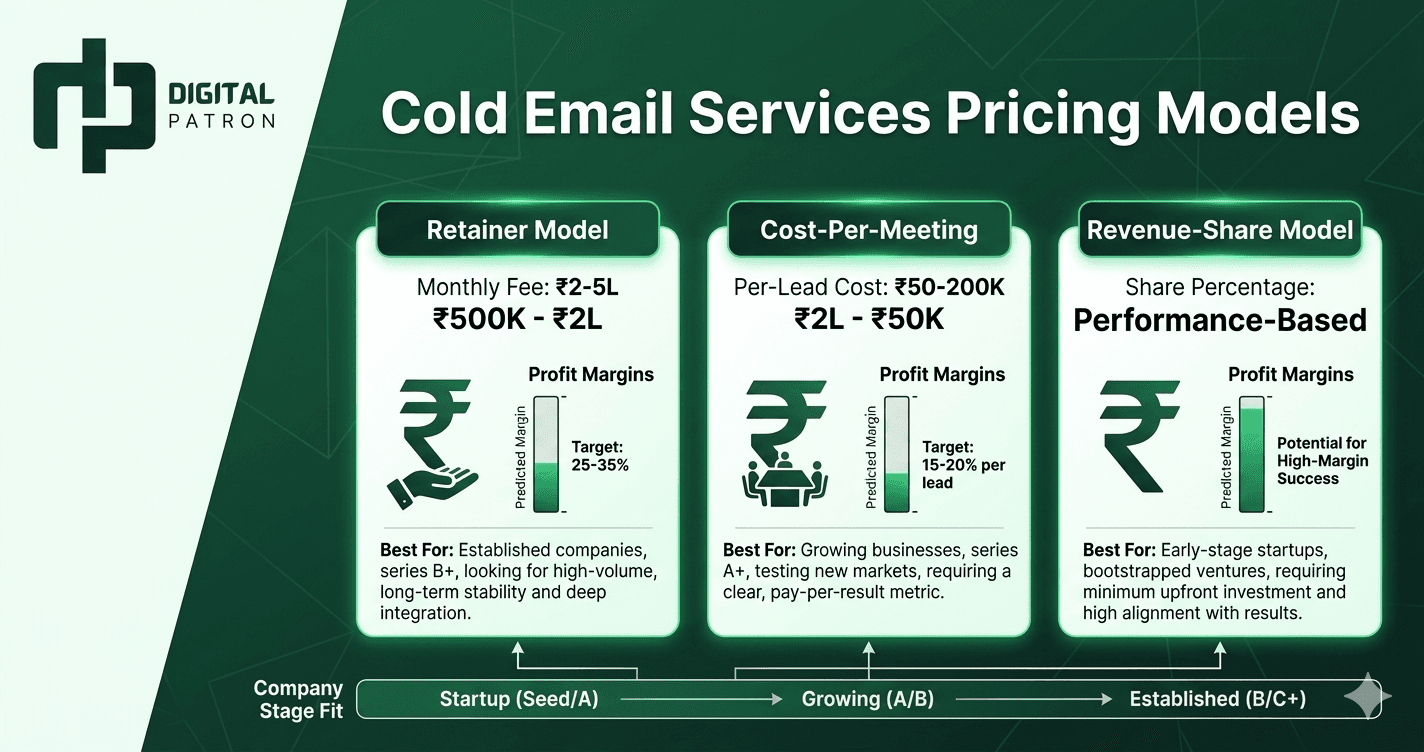
One published result from this architecture: a single Instantly campaign we ran sent 7,000 emails at a 74.7% open rate and 17.8% reply rate, producing 136 opportunities and $308,550 of pipeline. That is one campaign, not an average, and it was for a client with a sharp ICP and a strong offer; the tools did not create either. The same setup is sold on its own as email deliverability setup from $499, and as managed cold email outreach from $899 a month if you would rather not run it yourself.
Common mistakes we see Indian startups make
- Sending cold email from the company domain. The most expensive mistake on this list, because the damage lands on the domain you cannot change. Buy look-alike domains before you buy any tool.
- Paying for Apollo Professional for the AI features before the list is right. The Basic plan's filters are the part that makes or breaks a campaign; upgrade when you are hitting credit limits, not before.
- Treating Instantly's lead finder as the only data source. It is fine for a first broad list and thin for narrow Indian or mid-market personas. Check a sample of verified emails before trusting it.
- Skipping warmup because the plan says "unlimited". Unlimited mailboxes does not mean unlimited volume per mailbox on day one. Two to three weeks, then ramp.
- Buying annual plans in month one. The annual discount is 20% on both tools; the cost of being locked into the wrong tool for a year is larger. Pay monthly until the campaign is working.
- One mailbox per rep. Rotation across many mailboxes is the single biggest deliverability lever; a rep with one mailbox at 150 emails a day is a spam complaint waiting to happen.
- No human reading replies. Both tools will auto-classify, and both will misread a polite "not now" as interest. Someone has to read the positive folder daily.
Frequently asked questions
Is Apollo or Instantly better for cold email?
For the sending part, Instantly: rotation, a warmup pool and a unified inbox are its core product, while Apollo caps volume per mailbox and retired native warmup in 2024. For finding who to email, Apollo. Most teams doing real volume use both.
Can I use only Apollo for cold email?
Yes at founder volume, from one or two mailboxes on a free or Basic plan. Past a few hundred emails a day you will want a dedicated sender, because Apollo's per-mailbox caps and lack of rotation make volume awkward and deliverability harder to control.
Can I use only Instantly?
Yes if you already have a list or your persona is broad enough for Instantly's lead finder. Its Starter bundle ($85 a month billed annually) packages outreach and 1,500 credits for exactly this case. For narrow personas, verify the data quality on a sample first.
How much does Instantly cost in 2026?
Outreach plans are $37.60 (Growth), $77.60 (Hypergrowth) and $286.30 (Light Speed) a month billed annually, or $47, $97 and $358 billed monthly, per the pricing page on 14 October 2026. Lead credit plans start at $37.60 a month billed annually, and bundles start at $85.
How much does Apollo cost in 2026?
Apollo's pricing page lists Free, Basic, Professional and Custom plans. The offer data embedded in the page gives Basic at $49 and Professional at $99 per user per month; the rendered annual-versus-monthly figures were not readable by our check, so confirm on the page. All seats on one account must be on the same plan.
Do I need lemlist as well?
Usually not as a third tool. lemlist (Email plan $55 per user per month billed annually, $69 monthly; Multichannel $87 billed annually, $109 monthly) competes with both by bundling a lead database, warmup and LinkedIn steps. Pick it instead of the pair if you want one tool and LinkedIn automation matters more than sending depth; see our lemlist pricing page.
Next step
If you would like us to look at your current tools, domains and list and tell you which to pay for first, request a free outbound audit. If you would rather have the stack run for you, managed cold email outreach starts at $899 a month and deliverability setup at $499; full pricing is on our pricing page.
Further reading
- Apollo pricing explained
- Instantly pricing explained
- lemlist pricing explained
- Apollo vs Smartlead vs Instantly: which cold email tool wins in 2026
- AI SDR vs hiring an SDR in India: cost per booked meeting
- Cold emails going to spam: 7 fixes
Sources (checked 14 October 2026)
- Instantly, instantly.ai/pricing: outreach, credit and bundle plan prices, annual and monthly
- Apollo, apollo.io/pricing: plan descriptions, same-plan-for-all-seats rule, Gmail-only connection on free plans, and the embedded offer data listing Basic at $49 and Professional at $99 per user per month
- Costbench, Apollo.io pricing changelog (third-party tracker reporting higher monthly-billing figures in August and October 2026 snapshots; cited only as the reason to confirm the toggle)
- lemlist, lemlist.com/pricing: Email $55 annual / $69 monthly, Multichannel $87 annual / $109 monthly per user
- Digital Patron: cold email track record (the single Instantly campaign figures), email deliverability setup and Gurgaon SaaS cost breakdown (warmup lesson)