
Short answer: an app "like Zomato or Swiggy" is not one app, it is four: a customer app, a restaurant app, a delivery partner app and an admin panel, all sharing one backend with real-time order tracking and payments. In India in 2026 that puts a first version in the complex app band of our mobile app development cost guide: typically ₹25 lakh to ₹75 lakh or more, over 16 to 30+ weeks. If you only need one restaurant or a small chain to take orders directly, without running your own delivery fleet, you are usually in the mid-complexity band of ₹8 lakh to ₹25 lakh over 10 to 16 weeks. These are market ranges, not a Digital Patron price list. We quote a fixed price after discovery.
Why a food delivery platform is a "complex app"
Our cost guide sorts apps into three bands. A simple app (₹3 lakh to ₹8 lakh, 6 to 10 weeks) is a catalogue or content app. A mid-complexity app (₹8 lakh to ₹25 lakh, 10 to 16 weeks) has OTP login, payments, profiles, an admin dashboard and push notifications. A complex app (₹25 lakh to ₹75 lakh+, 16 to 30+ weeks) is a two-sided marketplace, real-time tracking, chat or offline sync.
A Zomato or Swiggy style platform hits every item on the complex list at once:
- Three sides, not two: diners, restaurants and delivery partners each have their own app and their own rules, plus your operations team on the admin panel. Our guide puts it plainly: a customer app, a vendor app and an admin panel is three products sharing a backend. Food delivery adds a fourth.
- Real-time everything: order status, rider location on a map, restaurant accept or reject, rider assignment. Real-time features are the single biggest cost driver in mobile work.
- Payments with money moving three ways: the customer pays you, you settle with the restaurant and you pay the rider. Refunds, failed payments, cancellations and GST invoices are where payment work grows.
- Maps and location: delivery radius, distance-based fees, live route display and rider assignment by proximity add build time and a recurring API bill.
What you see in Zomato and Swiggy today is years of work by large teams. Nobody should try to build all of it in version one. The rest of this guide shows what a realistic first release contains.
Cost by scope: which band are you in?
| What you are building | Typical market band (INR) | Typical timeline |
|---|---|---|
| Single restaurant or small chain ordering app: menu, cart, OTP login, online payment, order status, simple admin. Delivery by your own staff or a third-party courier. | Mid-complexity: ₹8 lakh – ₹25 lakh | 10 – 16 weeks |
| Multi-restaurant marketplace in one city: customer, restaurant, delivery partner and admin apps, live tracking, payouts, ratings. | Complex: ₹25 lakh – ₹75 lakh+ | 16 – 30+ weeks |
| The same marketplace adding multiple cities, subscriptions, dynamic delivery fees, in-app chat, promotions engine and analytics in version one. | Upper end of complex, often above ₹75 lakh | 30+ weeks |
Add 18% GST on invoices from registered vendors. Building once in React Native or Flutter rather than two native apps typically costs 25 to 40% less, and for a four-app platform that saving applies to three of the four apps (the admin panel is a web app either way).
The four apps and what goes in each
1. Customer app (iOS and Android)
- Sign-up and OTP login, saved addresses, location detection
- Restaurant listing by distance, search, filters, cuisine categories
- Menus with item options and add-ons, cart, coupon field
- Checkout with UPI, cards, wallets and cash on delivery
- Live order status and rider location on a map
- Order history, reorder, ratings and reviews, support or help screen
- Push notifications for order updates
2. Restaurant app or panel
- Accept or reject incoming orders, with an audible alert
- Mark preparing and ready for pickup, set preparation time
- Menu management: items, prices, photos, out-of-stock toggles, opening hours
- Earnings, settlements and order reports
Many platforms start the restaurant side as a tablet-friendly web panel rather than a store app, which is cheaper and easier to update.
3. Delivery partner app (usually Android first)
- Onboarding with document upload and approval by your team
- Go online and offline, receive and accept delivery requests
- Navigation to the restaurant and the customer, pickup and delivery confirmation (OTP or photo)
- Background location sharing while on a delivery
- Earnings, payouts and trip history
Most delivery partners in India use Android phones, so launching the rider app on Android first is a common way to cut the first bill.
4. Admin panel (web)
- Restaurant and rider onboarding, approvals and suspensions
- Live order board with manual reassignment
- Commission rates, delivery fees, delivery zones and coupons
- Refunds, disputes and customer support tools
- Settlement reports for restaurants and riders, GST-ready exports
The admin panel is the piece most often missing from cheap quotes, and the one your operations team will live in. It can look plain; customers never see it.
Build phases and timeline
- Discovery and prototype (about 2 to 3 weeks). User flows for all four sides, the order lifecycle (placed, accepted, preparing, picked up, delivered, cancelled, refunded), payment and settlement rules, and a clickable prototype. Product and UX design is usually 10 to 15% of the budget and the cheapest place to find mistakes.
- Backend and admin foundations. APIs, database, authentication, the order state machine, payments and the first admin screens. For a marketplace the backend is as large as the mobile work.
- Customer, restaurant and rider apps in parallel. Built against the same API, with installable test builds every week.
- Real-time tracking, notifications and payouts. Live location, rider assignment, push notifications, refunds and settlement reports.
- Pilot in one area. A handful of restaurants and riders in one locality before a public launch. This is where assignment rules, delivery radius and preparation-time estimates get corrected.
- Store release and handover. App Store and Google Play listings, privacy declarations, review feedback, then a maintenance retainer or handover to your team.
Across those phases, a single-restaurant ordering app typically lands in 10 to 16 weeks, and a four-app marketplace in 16 to 30+ weeks. Slow decisions, late menu content and payment gateway approvals delay projects more often than coding does.
What an app costs in India (2026 market ranges)
Market ranges, not a Digital Patron price list. Hover or tap a band.
Source: our app development cost guide. Get a range for your own scope with the app cost calculator; we quote a fixed price after discovery.
Third-party costs: maps, SMS and payment gateway
These bills arrive after launch and scale with orders. Check each vendor's own pricing page before you build a business case, because they change. The figures below are from the vendors' pages, checked 1 November 2026.
| Item | How it is charged | Notes |
|---|---|---|
| Payment gateway | A percentage fee per successful transaction | For example, Razorpay's pricing page lists a 2% platform fee on domestic payment methods, 18% GST on that fee, and no setup or annual maintenance charge (checked 1 Nov 2026). Split settlements to restaurants and riders may need a separate marketplace or route product; ask your gateway. |
| Maps and location | Free monthly allowance, then pay as you go | Google Maps Platform's India pricing lists up to 70,000 free calls per SKU a month for Essentials, 35,000 for Pro and 7,000 for Enterprise, with usage above that billed (checked 1 Nov 2026). Maps, autocomplete, directions and distance calls are separate SKUs, so a busy platform uses several. |
| SMS OTP and order updates | Per message | Login OTPs and order SMS add up with growth. In India, businesses sending commercial SMS register sender IDs and message templates on the telecom DLT system; your SMS provider handles the process. Many platforms move order updates to push notifications or WhatsApp to keep SMS for OTPs only. |
| App stores | US$99 a year (Apple), US$25 one-time (Google Play) | Required to publish. The developer accounts should be in your company's name. |
| Backend hosting and database | ₹2,000 – ₹50,000+ a month | Scales with users, orders and real-time load. Lunch and dinner peaks matter more than the monthly average. |
Maintenance after launch
Budget 15 to 25% of the build cost a year for maintenance, a common rule of thumb. That covers OS compatibility, store policy changes, security updates, dependency upgrades and small fixes, not new features. A four-app platform needs this on every app: Apple ships a major iOS release every year, and Google Play requires apps to target a recent Android API level to keep publishing updates. Feature work after launch, such as subscriptions, scheduled orders or a loyalty programme, is new scope on top.
How to keep version one inside budget
- Prove one city, one locality first. Ship the order loop end to end for a small area before adding cities, zones or dynamic pricing.
- Go cross-platform for the customer and rider apps unless there is a written reason not to.
- Start the restaurant side as a web panel and the rider app on Android only.
- Use managed services for authentication, push notifications and file storage rather than building your own.
- Leave out in-app chat, a promotions engine, multi-city admin and analytics dashboards until orders justify them.
- Pay for discovery. Two to three weeks with a clickable prototype is the cheapest way to find out what you are really building.
Restaurant ordering apps vs a delivery marketplace
Most restaurant owners asking about "an app like Zomato" do not need a marketplace. They want their own customers to order directly, without paying aggregator commission on every order. That is a single-brand ordering app: a customer app, a simple restaurant or kitchen panel and an admin view, with delivery handled by their own staff or a courier service. It sits in the mid-complexity band, around ₹8 lakh to ₹25 lakh. If that is your case, see our page on restaurant and food ordering app development in Noida, which covers ordering-app scope for restaurants and cloud kitchens in Delhi NCR.
How Digital Patron prices a food delivery build
Digital Patron builds native Android and iOS apps and cross-platform apps in React Native or Flutter, with the backend and admin tools included, from offices in Gurugram and Mohali. We do not publish a rate card for app builds. After a discovery call we write a statement of work listing every app, screen, integration and milestone with a fixed price; where requirements are still moving, we start with a short paid discovery and clickable prototype instead. You get installable builds every week, and the code repository and store accounts are in your name.
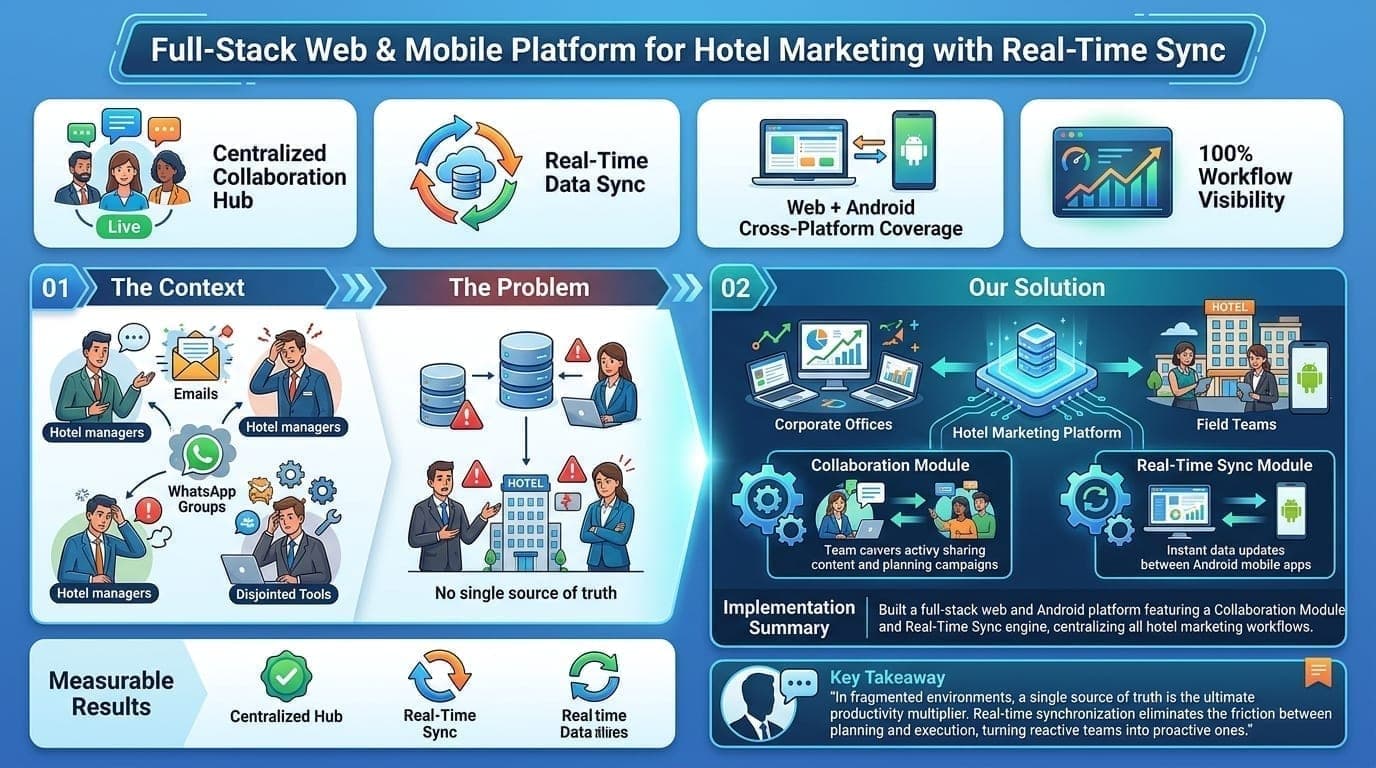
The closest published example of the multi-app pattern is The Hotel Media: a web platform for the corporate team and a native Android app for field teams, built against one API with a real-time sync layer. If you are validating the idea before a full platform, our MVP development service scopes the smallest version that proves demand. For the wider approach see app development, and for a range on your own feature list try the app cost calculator.
Frequently asked questions
How much does it cost to build an app like Zomato or Swiggy in India?
A first version with customer, restaurant, delivery partner and admin apps, real-time tracking and payments typically falls in the complex app band of ₹25 lakh to ₹75 lakh or more in 2026, over 16 to 30+ weeks. The full feature set in those apps today is years of work by large teams, so price version one around the core order loop.
How much does a restaurant ordering app cost in India?
An ordering app for one restaurant or a small chain, with menu, cart, OTP login, online payment, order status and a simple admin, is a mid-complexity app: usually ₹8 lakh to ₹25 lakh over 10 to 16 weeks. It costs less than a marketplace because there is no rider app, no payouts to many restaurants and less real-time work.
How long does it take to build a food delivery app?
A single-restaurant ordering app typically takes 10 to 16 weeks. A four-app delivery marketplace usually takes 16 to 30 weeks or more, including discovery, a pilot in one area and store release. Payment gateway approvals, menu content and slow decisions cause more delay than coding does.
What are the running costs of a food delivery app after launch?
Budget 15 to 25% of the build cost a year for maintenance, plus hosting, per-message SMS, maps usage above the free allowance, payment gateway fees per transaction and the app store accounts: US$99 a year for Apple and US$25 once for Google Play.