
Guaranteed meetings vs retainer cold email: what to choose
Short answer: an agency that sells "guaranteed meetings" is selling you a quantity promise, and the price of that promise is built into either a higher monthly fee, a per-meeting charge, or a longer contract. A retainer agency sells you the work: list building, sending domains, copy, sending and reply handling, for a flat monthly fee, with the meeting count as a planning range rather than a promise. Digital Patron is a retainer agency. It does not sell guaranteed meetings; it charges $800 a month, 2-month minimum, no setup fee.
What "guaranteed meetings" usually means
Read the contract before the sales deck. In practice a meeting guarantee tends to mean one of three things:
- A quantity floor. "At least X meetings a month." If the floor is missed, the usual remedy is a credit or a free extra month, not a refund. The definition of "meeting" is the whole game: a calendar invite accepted counts for many agencies, whether or not the prospect turns up or fits your ideal customer profile.
- Pay per meeting. You pay a fixed amount for each meeting that is booked, or in better contracts, each meeting that is held. Lower risk on paper, but the agency is paid for volume, so the incentive is to book anyone who will say yes, and qualification suffers unless the contract defines a qualified meeting tightly.
- A performance clause on a retainer. A monthly fee plus a bonus per meeting, or a fee reduction if a target is missed. This is the most balanced version and the rarest.
None of these is dishonest in itself. The problem is that "guaranteed" is doing a lot of work in the headline and much less in the contract.
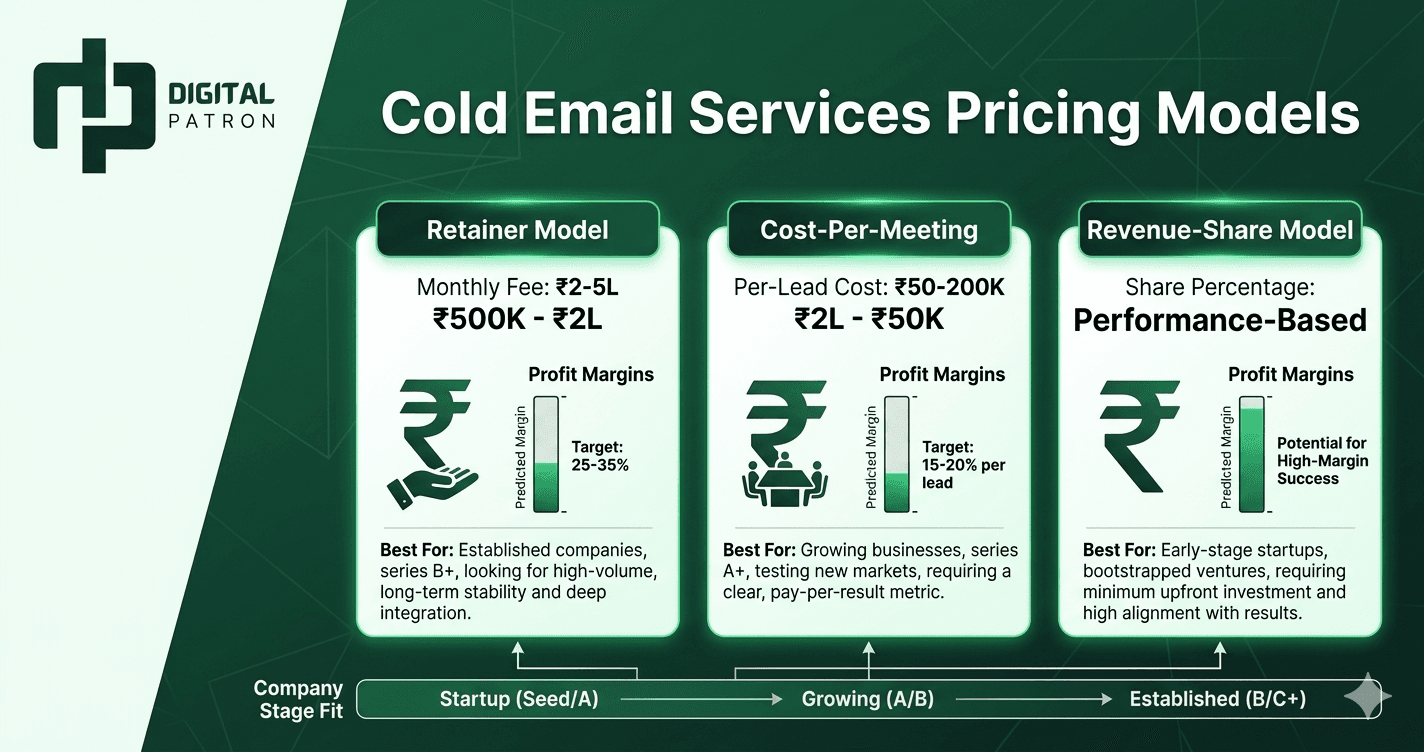
Pay-per-meeting vs retainer
| Pay per meeting | Monthly retainer | |
|---|---|---|
| What you pay for | Each meeting booked or held | The outbound work, every month |
| Who carries the risk of a slow month | The agency, on paper | You |
| Incentive for the agency | Book as many meetings as possible | Keep you as a client, so book meetings you will keep |
| Where it goes wrong | Meeting quality, no-shows, disputes over what counts | Thin reporting, no accountability for a bad month |
| Typical contract length | Often longer, to recover setup costs | Monthly or a short minimum (Digital Patron: 2 months) |
| Best for | Teams with a very broad buyer and an in-house closer who can absorb no-shows | Teams with a defined ICP who want the system built and run |
A useful test: ask the pay-per-meeting agency what happens when a prospect accepts an invite and does not show. If the answer is "it still counts", you are buying calendar invites, not conversations.
Red flags when choosing a cold email agency
- No published price. If the price only appears after a discovery call, the price is whatever they think you can pay. Published pricing is a sign the agency sells the same thing to everyone.
- Guarantees without a definition of "meeting". Ask for the written definition: ICP match, held or booked, minimum duration, who attends.
- Sending from your main domain. Cold email belongs on separate sending domains with their own mailboxes, so a bad week cannot hurt the domain your company runs on. An agency that asks for access to your main Google Workspace or Microsoft 365 tenant for cold sending is a risk.
- No SPF, DKIM and DMARC conversation. Google and Yahoo require bulk senders to authenticate with SPF and DKIM and to publish a DMARC policy. If the agency cannot explain how it sets these up and aligns them to the From domain, its emails will land in spam and it will blame your offer.
- No warm-up period. New domains and mailboxes need weeks of warm-up before volume. An agency promising first sends in the first week on fresh domains is promising spam-folder placement.
- Human SDRs billed as "AI". Ask who writes the copy, who reads the replies and who books the meetings. Either answer can be fine; the mismatch between the pitch and the delivery is the problem.
- Long contracts with early-exit penalties. Twelve-month contracts for a channel that shows results in six to eight weeks are there to protect the agency, not you.
- No reply handling in the price. A campaign that generates replies nobody reads for two days loses most of its meetings. Check whether reply handling is included or an add-on.
Digital Patron's model
Digital Patron does not sell guaranteed meetings or pay-per-meeting. It runs done-for-you cold email and AI SDR outbound for a flat $800 a month with a 2-month minimum and no setup fee, billed in USD; Indian clients are invoiced in INR with GST. The fee covers the ICP lead list, dedicated sending domains and mailboxes, SPF, DKIM and DMARC, warm-up, sequence copy, sending and reply handling, with CRM sync and weekly reporting; the LinkedIn add-on is scoped on the call. Tool seats and data credits are additional.
The meeting figure we publish is a planning range, 8 to 14 booked meetings a month for the package scope, and we say so on the pricing page rather than calling it a guarantee. The documented proof is one client's outcome: an Austin, Texas B2B SaaS company retired a $20,000 a month SDR team, booked 22 qualified meetings in 21 days, and cut its cost per meeting from $1,200 to $350. That is the Texas SaaS case study, one client's result, not an average.
If you want to see the targeting before you pay anything, Rumo, our free AI SDR agent, reads your website, maps your ideal customer profile and delivers 20 B2B leads within 6 hours. One run per company, no card. If you would rather talk first, book a call.
Frequently asked questions
Do any cold email agencies really guarantee meetings?
Some sell a quantity floor or a pay-per-meeting price. The guarantee is only as good as the contract's definition of a meeting and the remedy when the number is missed, which is usually a credit rather than a refund. Treat the word as a pricing model, not a promise of pipeline.
Is pay-per-meeting lead generation available in India?
Yes, several Indian agencies price appointment setting per meeting. Digital Patron does not; it charges a $800 a month retainer with a 2-month minimum and no setup fee, and publishes its meeting figure as a planning range.
What should a cold email agency contract include?
The price and what it includes, the minimum term and exit terms, who owns the sending domains and the data at the end, how SPF, DKIM, DMARC and warm-up are handled, whether reply handling is included, and, if there is a guarantee, the written definition of a meeting and the remedy.
How do I choose between a retainer and pay-per-meeting?
Choose pay-per-meeting if your buyer is broad, your closer can absorb no-shows and you have no budget for a slow month. Choose a retainer if your ideal customer is specific and you want the sending system built, owned and run properly, because that is what a flat fee pays for.