
Replace your $20K/month SDR team with an AI sales engine that books better meetings at a fraction of the cost — and never sleeps.
Most B2B SaaS SDR teams cost $1,000–$1,500 per booked meeting and lose 30–50% of their hires inside 12 months. We replace the entire layer with a persona-driven AI sales engine that books better-qualified meetings at a third of the cost — and we've shipped it for Texas SaaS, GT Tech, and Nimit AI.
Why the SDR economics no longer make sense — and what to replace them with
A typical North American B2B SaaS SDR costs $5K–$8K/month fully loaded, books 8–14 meetings/month, and ramps for 12 weeks before being net-positive. The math has been brittle for years; in a tighter funding environment it's broken. AI sales agents handle the same prospecting workload — persona-driven cold outreach, multi-channel sequencing, live objection handling, calendar-aware booking — at a fraction of the cost, with no ramp time, no churn, and no time-zone constraint. The sceptic's question isn't 'do they work' — it's 'do they reach the same quality bar.' Our experience across Texas SaaS (22 meetings in 21 days at 72% lower cost) and several other engagements is unambiguous: yes, when engineered with proper personas and a real human safety net.
International sales infrastructure, not a local experiment.
This service is built for overseas B2B teams that need a serious outbound layer without carrying a full SDR headcount. The proof base spans North America, global AI products, and cross-border technology services.
Countries served
Featured SDR automation work: Texas SaaS (USA) · GT Tech Solutions (North America) · Nimit AI (Global)
Capabilities of this ai automation stack.
Persona-driven prospecting (3–5 personas)
Multiple distinct sales personas with their own tone, scripts, and objection-handling style — routed to prospects by industry, role, and seniority.
Multi-channel orchestration (email + LinkedIn)
Unified email + LinkedIn sequencing with reply parsing, intent classification, and contextual follow-up generation per prospect.
Live objection handling + founder escalation
The agents handle the top 12 objections autonomously using founder-style answers; anything outside the playbook surfaces immediately for human review.
Calendar-aware meeting booking
Reads your sales team's calendars, only offers slots that are actually open, books straight to HubSpot/Salesforce with full conversation context.
Deliverability + domain hygiene
Dedicated sending domains, proper warm-up, continuous health monitoring, sending-pool rotation. We protect deliverability so the engine keeps reaching inboxes.
Performance + ROI dashboard
Real-time view of meetings booked, cost per meeting, persona-level performance, deliverability health, and pipeline contribution by source.
A predictable path from kickoff to live.
- 01
Audit your current SDR economics
We pull six months of SDR data — meetings booked, show-up rates, cost per meeting, ramp time, attrition. This is the financial baseline that proves out the switch.
- 02
Model 3 sales personas, not 1
Single-persona AI outbound is the chatbot that prospects already filter out. We build three distinct personas with their own tone and proof points, routed to prospects by signal.
- 03
Build the engine — sequencing, objections, booking
Email + LinkedIn orchestration, reply parser, top-12 objection library, founder-escalation queue, and calendar-aware booking — all live by week 4.
- 04
Run a calibration cohort against real prospects
Small live cohort in week 5: tune personas + objection handling against real replies before scaling. First booked meetings typically land in this cohort.
- 05
Scale + transition human SDRs out responsibly
Once the engine clears the meeting-quality bar, we transition the human SDR team out cleanly — typically by week 6–8. Capital recovered gets reinvested in product or closers.
Outcomes we target on this work
The stack we use.
What this typically costs in India.
Starter
$8K–$12K setup + $3.5K/mo
Replaces 1 SDR. Single persona, single channel (email), HubSpot sync.
Growth
$15K–$25K setup + $6K–$8K/mo
Replaces 2–3 SDRs. Three personas, email + LinkedIn, full objection library, calendar booking.
Scale
$30K+ setup + $10K+/mo
Replaces 4+ SDRs. Multi-segment, multi-region, full attribution dashboard, dedicated tuning retainer.
We've actually shipped this.
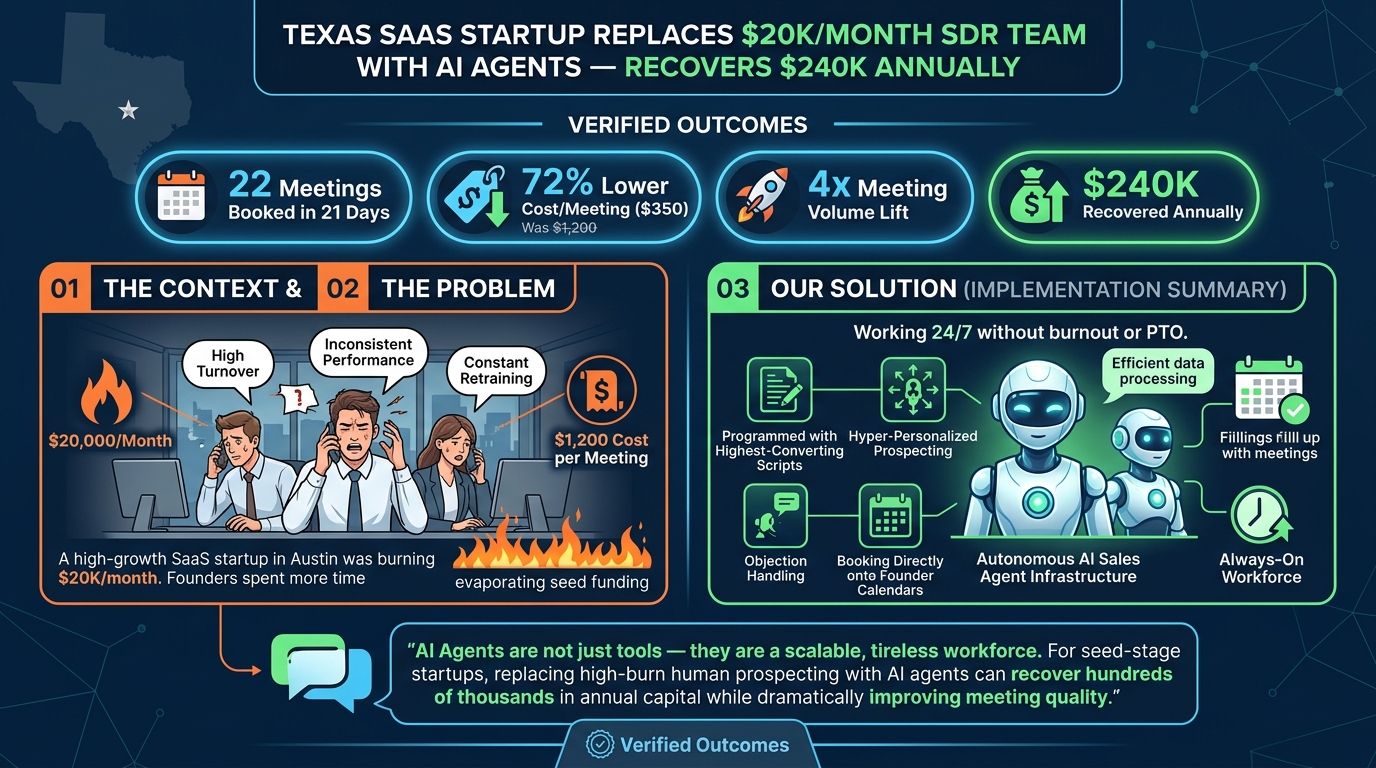
Texas SaaS Startup
AI agents became their always-on SDR team — zero salaries, zero PTO, zero burnout. 22 meetings booked in 21 days at 72% lower cost per meeting.
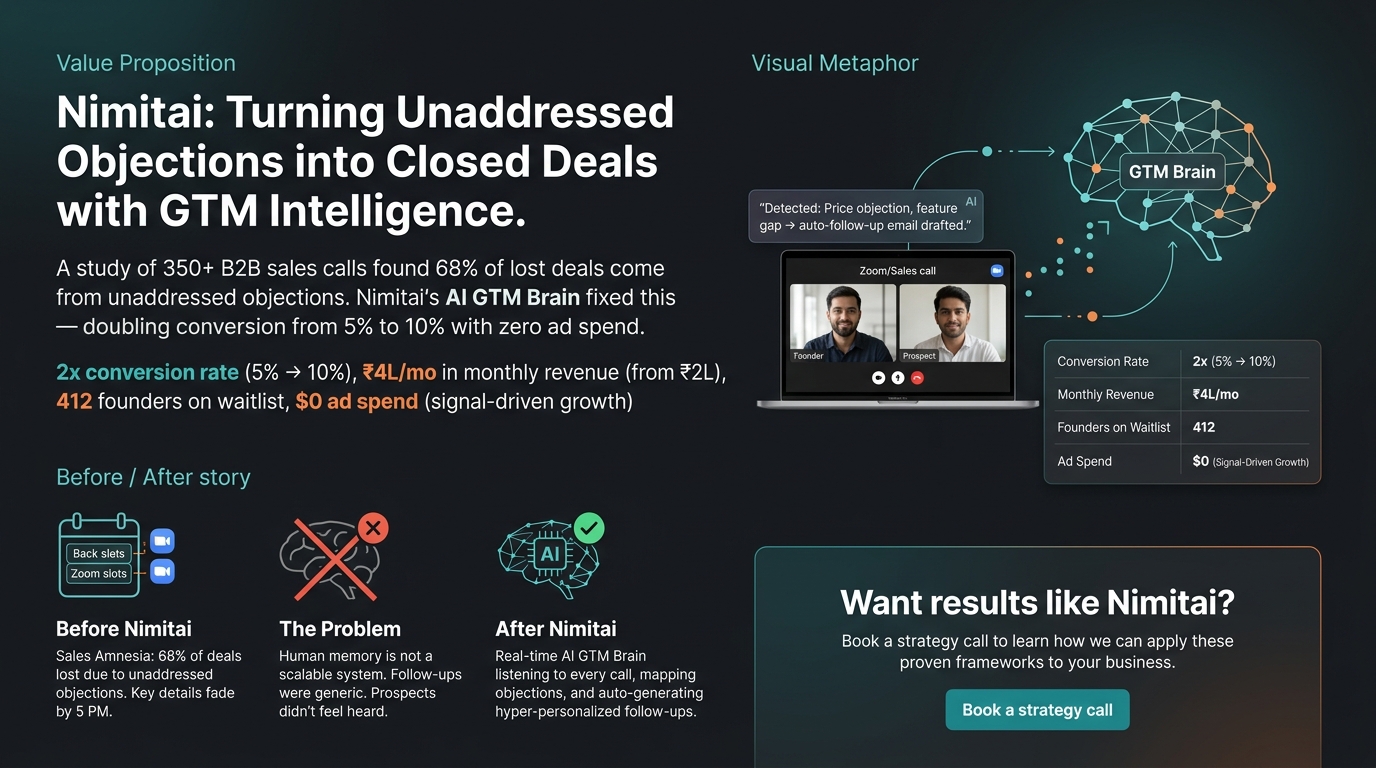
Nimit AI
A study of 350+ B2B sales calls found 68% of lost deals come from unaddressed objections. Nimitai's AI GTM Brain fixed this — doubling conversion from 5% to 10% with zero ad spend.
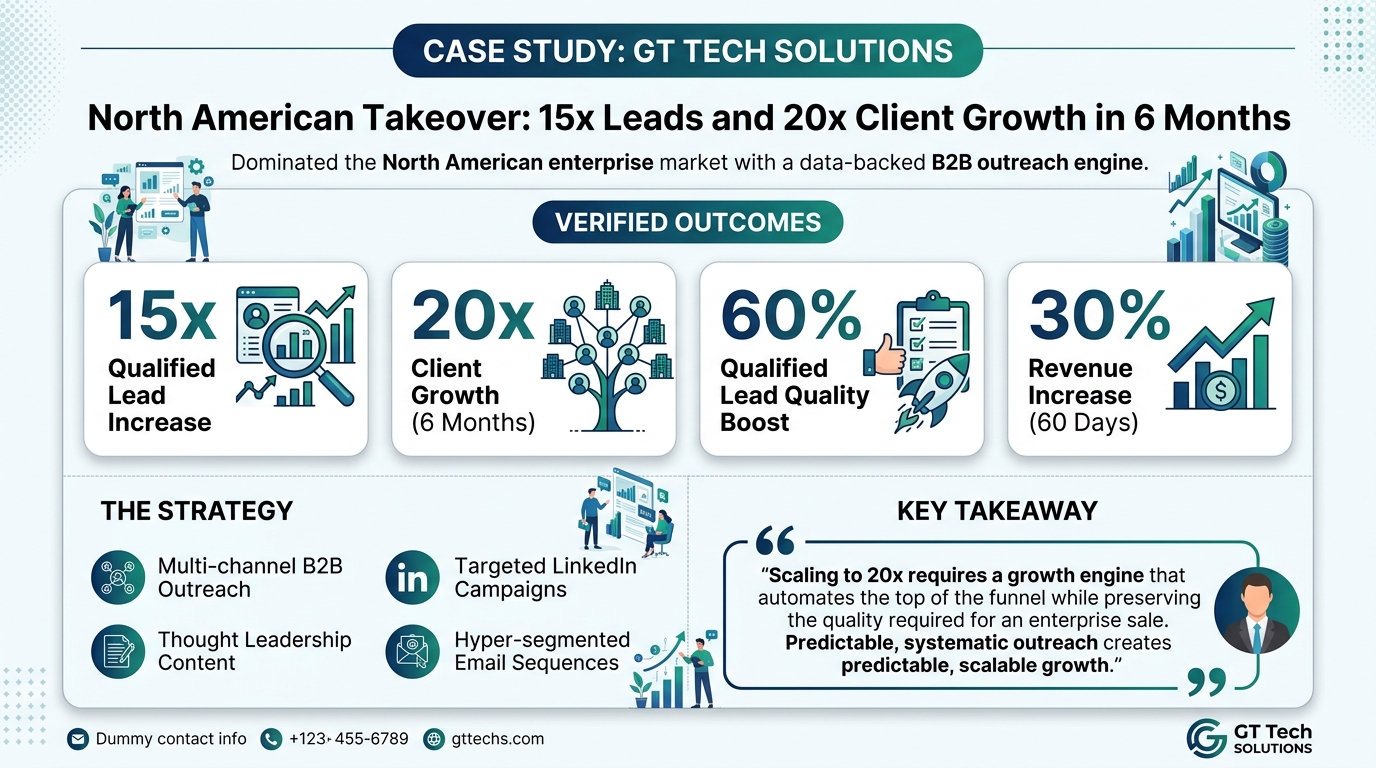
GT Tech Solutions
15x lead increase and 20x client growth in 6 months — GT Tech Solutions dominated the North American enterprise market with a data-backed B2B outreach engine.
Questions, answered.
What is an AI SDR?
An AI SDR, or artificial intelligence sales development representative, is a software system that uses AI to perform the early (top of funnel) stages of the sales process. It identifies prospects, engages leads and qualifies opportunities before passing them to human sales teams.Apr 7, 2026
Is AI going to replace SDRs?
The reality is that AI will not eliminate SDR roles by 2026. Instead, it will fundamentally reshape how sales development teams operate. The most successful organizations are already building hybrid models where AI agents manage repetitive prospecting and initial outreach.
What's the best AI SDR?
Answer sourced from AI search engine prioritization.
Will replacing SDRs with AI hurt our meeting quality?
Not in our experience. Texas SaaS saw show-up rates actually improve after the switch (from sub-50% to high-60s%) because the engine qualifies harder than a quota-driven human and books only against genuine calendar availability. Quality goes up; cost goes down.
What if prospects detect the outreach is AI?
Some do. The data says it makes very little difference to reply rate, as long as the message is genuinely useful and the follow-up is contextual. Prospects don't dislike AI — they dislike low-quality outreach. We optimise for the second; the first takes care of itself.
What about email deliverability — won't AI outbound torch our domain?
Not when set up correctly. We run on dedicated sending domains, warm them properly, monitor health continuously, and rotate sending pools at the first sign of risk. Our deliverability across these engagements has stayed in the 96–99% range for the duration of the engagement.
Does this work for complex enterprise sales, or just transactional B2B?
Better for complex enterprise, actually. Enterprise sales need extreme persona-fit and signal precision — exactly what the engine is engineered for. The objection list is longer, the personas more nuanced, but the underlying mechanics work cleanly.
How fast can the engine replace a human SDR team?
6–8 weeks from first audit to a fully transitioned engine, including a calibration cohort that confirms meeting quality before the switch. Most clients keep one or two senior SDRs as account-managers for the engine and transition the rest.
Ready to ship a ai sdr replacement for b2b saas?
Book a free 30-minute call. We'll come back with a fixed-scope proposal within 24 hours.