
How to get US clients from India: the cold outreach playbook (real numbers)
Why this playbook exists
India's roughly 70-million SaaS-adjacent founder pool keeps asking the same question: how do you actually land your first US client without an office in the US, an American partner, or a marquee VC introduction? The vendors selling courses and "go global" workshops on this are mostly lying about how hard it is — or, more charitably, they are selling the playbook that worked in 2019 and still slides into 2026 decks.
The honest 2026 version: it takes 90 days, ₹3–₹5 lakh in tooling and infrastructure, and a system that handles four specific gaps — timezone, payment, credibility, and deliverability. None of these gaps is intractable. All of them require disciplined operational answers rather than founder-grit improvisation. This article is the playbook we run for Indian B2B teams who land their first US dollar. It is also the playbook that built Digital Patron's own US client base.
Gap 1: Timezone (which is actually your advantage, not your disadvantage)
The Indian-to-US timezone gap is a 9.5–13.5 hour difference depending on US coast. Most Indian founders treat this as a friction. It is, in fact, your single biggest unfair advantage if you operationalise it correctly.
The framing that loses: "I'll respond when they're awake." The framing that wins: "When their workday starts, they have already received my response from last night." Reply latency from an Indian team to a US prospect is structurally faster than US-team-to-US-prospect, because the Indian operator sees the email in IST morning and replies before the US prospect's day starts. We have closed deals where the US buyer commented on this directly — "you guys responded faster than the US agency we were also evaluating."
Operationalise it: have one teammate (or yourself) on a 7 AM IST start so that 9 AM EST inbound emails get a response within 2 hours of arrival. The cost is rotating the early shift across your team; the win is a measurable conversion advantage on US accounts.
Gap 2: Payment infrastructure (Stripe Atlas vs LLC vs INR invoicing)
This is where most Indian founders waste 4–8 weeks on the wrong setup. The decision is simpler than it looks; here is the honest tree:
- Direct INR invoicing via Wise / Razorpay: No US entity needed. You invoice in USD, the US client pays via Wise or Razorpay International, the funds land in INR in your Indian bank account, GST is applied as zero-rated export of services. Setup cost: ₹0. Time: 1–2 weeks. Use this for: services, agencies, consulting, custom software builds. Use this until: monthly USD volume crosses ~$30K consistently or US clients start asking for a 1099-equivalent for tax reasons.
- Stripe Atlas (US Delaware C-corp): $500 setup + ongoing US tax compliance (~$2–$4K/year in CPA fees). Gives you a US bank account, US-billing entity, and Stripe access. Use this for: SaaS products, recurring USD subscriptions, anyone who needs Stripe to take credit-card payments from US consumers/businesses. Time: 2–3 weeks for entity, 4–6 more weeks for full US bank + Stripe activation.
- US LLC via Doola / Firstbase: Cheaper than Atlas (~$300 setup, ~$1.5K/year compliance). Pass-through taxation, simpler structure. Use this for: agencies and services that want a US billing entity without C-corp tax overhead.
For 80% of Indian B2B founders going to US for the first time, INR invoicing via Wise is the right answer. Skip Atlas/LLC until USD revenue justifies the compliance cost. The "I need a US entity to look credible" instinct is mostly false — US clients of Indian agencies pay Indian INR invoices routinely once they understand the export-of-services framing.
Gap 3: USD pricing (the psychology and the math)
The single most-common pricing error Indian founders make: they convert their INR price to USD and offer it. This anchors them at a 1/4–1/3 of US-market price, communicates "cheap from India," and frames negotiations entirely around price-down rather than scope-up.
The version that works: price at US-market rates with India-cost-base economics. Specifically: do not lead with "₹3L/month" or its USD conversion. Lead with "$5,000/month" — within US-market range, defensible on scope, and producing 3–5x the gross margin you would have at converted INR pricing. The CAC arbitrage is real; capture it on the price side, not the volume side.
The honest exception: at the entry tier (your first 3 US clients, where references and case studies matter more than dollars), price slightly under US-market — $3,500–$4,500 against a market rate of $5,000–$8,000 — to win the proof points. Increase from your fourth US client onward.
Gap 4: Credibility hacks for Indian agencies/founders
The credibility gap is real but mostly fixable with operational discipline rather than capital. Five hacks that work:
- Founder Loom intros: a 90-second Loom video from the founder, addressed to the prospect by name, attached to the second touchpoint of every cold email sequence. Reply rates double in our tests; the video creates a visceral "real human, real face, real accent" trust signal that no email copy can substitute for.
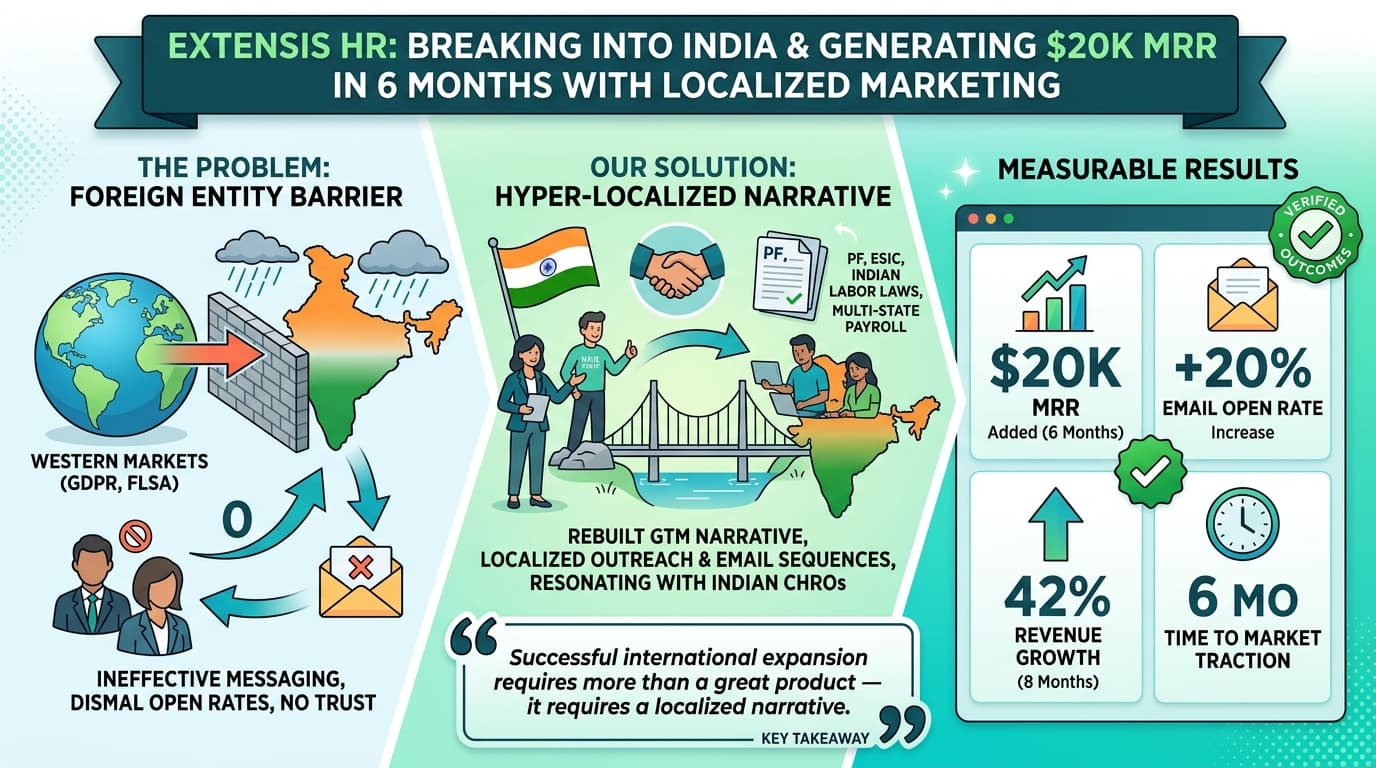
- Case studies formatted for US conventions: short, metric-led, screenshot-heavy. Indian-style case studies tend to be longer-form and narrative; US buyers skim. Restructure: 1-line problem, 1-line approach, 3 metrics, 1 quote. Our Extensis HR case study follows this format.
- US references — even one: a single existing US client willing to take a 15-minute reference call is worth more than ten testimonials. If you do not have one yet, the playbook is to land your first US client at a slight discount (gap 3) explicitly in exchange for them being your reference for the next five.
- US-friendly domain on cold email: send from a
.comdedicated domain, not from a.indomain. The country-code TLD signal subtly degrades cold-email conversion to US recipients; a.comsending domain removes that friction without misrepresentation. - US-style email signature: name + title + 1-line role + booking link. No "Best regards," no logo, no quotes, no compliance disclaimer block. US buyers read short.
Gap 5: The cold email playbook (specifically for India-to-US)
India-to-US cold email needs three operational answers that domestic cold email does not:
- Multi-domain sending hosted in US/EU infrastructure: detailed in our deliverability article — short version, do not send from Google Workspace mailboxes hosted in the India region; use a sending platform (Instantly, Smartlead) that routes through US/EU servers.
- Sending windows tuned to US workdays: the highest-converting send time for US East Coast B2B recipients in 2026 is 7:00–9:30 AM ET (which is 17:30–20:00 IST). Tuesday and Thursday outperform Monday/Friday by ~25%. Schedule accordingly.
- Indian-name handling: do not "Anglicise" your name in cold email. Buyers are smarter than that, and the dishonesty hurts reply quality. Use your real name; the credibility hacks above carry the rest.
The minimum viable India-to-US cold email setup: 4 dedicated .com sending domains, 4–6 weeks warmed up, sending platform routed through US infrastructure, 2,000-lead persona-tight sequences, Loom-video second touch, US-conventional email format. Realistic output: 8–14 booked meetings/month from a 2,000-lead campaign, at $5K–$8K average ACV. The productised version with all of this preconfigured lives at Cold Email Outreach at Scale, and our cold email agency page for US B2B companies explains how we run US campaigns, including CAN-SPAM requirements.
The honest 90-day timeline to first US dollar
- Days 1–14: payment infra (Wise / Razorpay International activation), domain procurement (4 dedicated
.comdomains), DMARC/SPF/DKIM stack, sending platform setup, ICP definition. Cost: ₹40K–₹70K. - Days 15–45: domain warm-up (parallel), case-study restructuring (US-conventional format), founder Loom intro recording, first 200-lead pilot list curation. Cost: ₹30K–₹50K (mostly time).
- Days 46–60: first low-volume campaigns to pilot list, daily Postmaster monitoring, copy iteration based on first 30 replies. First booked meetings typically in week 8–9.
- Days 61–90: production cadence, first US discovery calls, proposal sent to 2–4 prospects, first signed contract. First USD revenue typically lands in days 75–90.
This is the disciplined version. Founders who improvise the early weeks (skip warm-up, send from primary domain, ignore Postmaster) routinely take 6–9 months to land their first US client instead of 90 days, and damage their primary domain in the process.
The one mistake that will set you back 90 days
If you take one operational instruction from this article: do not send cold email to US prospects from your primary domain. Use dedicated sending domains, full DMARC/SPF/DKIM, multi-domain rotation. The temptation is to "just try a small batch from founder@yourdomain.com first." Every founder who has done this and then tried to recover their primary domain reputation has lost 4–8 weeks. The cost of doing it right from day 1 is ₹40K and 4 weeks of warm-up. The cost of doing it wrong is months of email-deliverability rehab.
Beyond cold email: the channel mix that works for India-to-US after first revenue
Once you have your first 2–3 US clients, layer in:
- Founder-led LinkedIn: post 3–5x per week with substantive technical/strategic content, in English, addressed to a US ICP. Compounding inbound starts at month 6–9.
- SEO-targeted content for US buyers: case studies and pillar articles targeting US-buyer queries. Same compounding curve as LinkedIn but slower and more durable.
- Partner motions with US-based agencies: many US agencies are looking for offshore execution partners. Becoming a known, reliable execution partner for 2–3 US agencies generates 5–15 referred deals per year at zero CAC.
The 9-channel framework in our lead-gen pillar covers this in more detail; the India-to-US specific version is the same nine channels, weighted toward outbound and founder-led for the first 12 months.
Frequently asked questions
Do I need to incorporate in the US to bill US clients?
No. INR invoicing via Wise or Razorpay International handles up to ~$30K/month of USD revenue cleanly under India's export-of-services framework, with GST zero-rated. Incorporate (Stripe Atlas / Delaware C-corp / US LLC) only when you cross that threshold or need Stripe for self-service SaaS sign-ups.
Will US buyers care that I'm based in India?
Mostly no, in 2026. Indian B2B agencies have become normalised in US procurement after the post-2020 remote-work shift. The credibility hacks above (Loom intros, references, US-conventional case studies) close the residual gap. The buyers who would not work with an Indian agency for principled reasons will not be moved by anything you do; the rest convert at industry-typical rates.
What's the realistic conversion rate from cold email reply to closed US deal?
Industry benchmarks: 1.8–4.5% reply rate, 0.4–1.2% positive reply rate, ~25–35% positive-reply-to-discovery-call conversion, ~15–25% discovery-call-to-closed-deal conversion. Stack: 2,000 sends → 60 positive replies → 18 discovery calls → 4 closed deals. At $5K average ACV that is ₹16L/quarter from a single 2,000-lead campaign.
How much should I budget total for the first 90 days?
Conservative: ₹3–₹5 lakh covering payment infra, domains, warm-up, Loom production, sending platform fees, and case-study restructuring effort. Aggressive (managed agency execution): $2.4K–$5.4K USD/month for 3 months = ₹6–₹13 lakh equivalent — but with a substantially shorter learning curve and a 90-day timeline that almost always holds.
Want us to run this for you?
Book a free 30-minute call. We will look at your offering, your target US ICP, and your current motion, and tell you honestly whether the 90-day timeline is realistic for your specific situation — and what it would cost to outsource the entire setup. Either we run it as a managed service via the Cold Email Outreach at Scale package (or as appointment setting, where the booked meeting is the deliverable), or you take the playbook and run it yourself. Both are fine outcomes.