
How Extensis HR Broke Into India and Generated $20K MRR in 6 Months with Localized Marketing
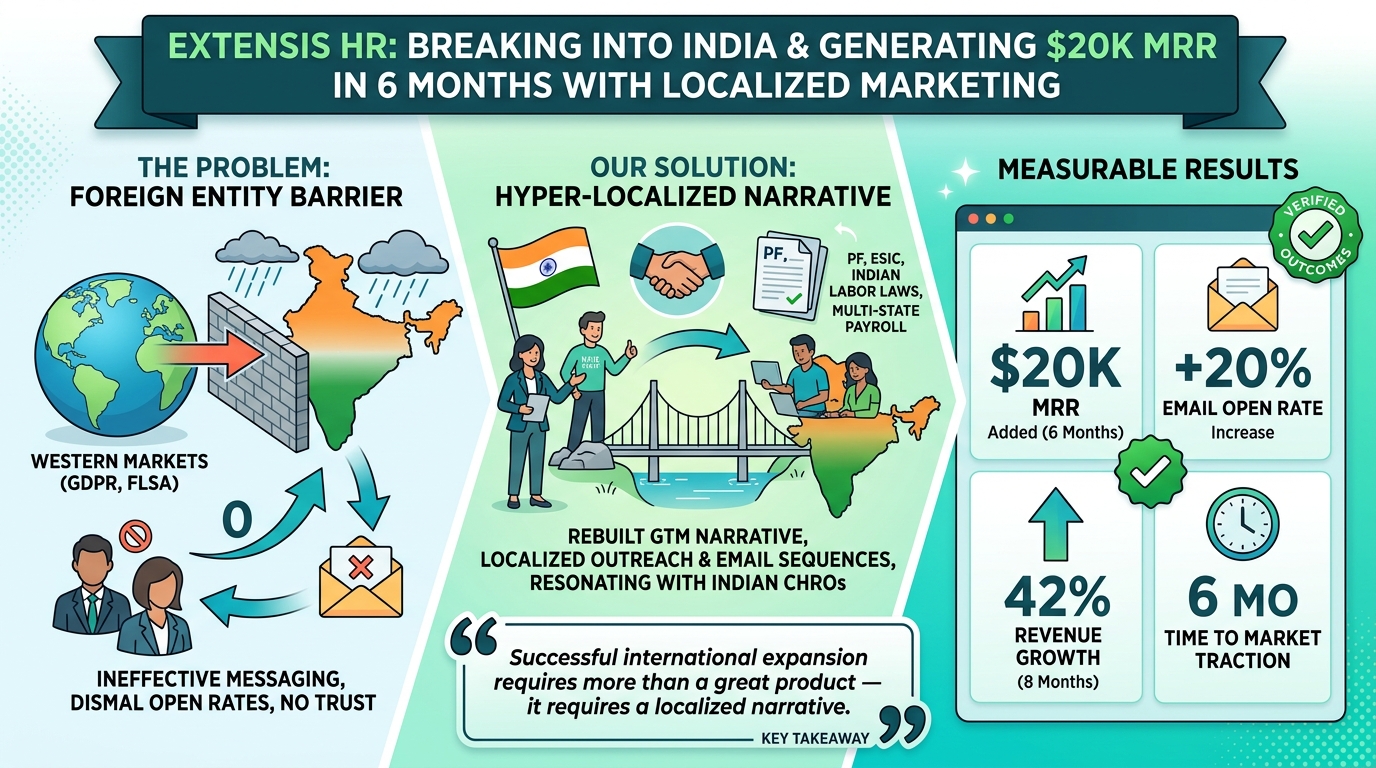
$20K MRR in 6 months — Extensis HR entered the Indian market with hyper-localized outreach, achieving 42% revenue growth within 8 months.
Verified Outcomes
The Brief
Engagement summary at a glance.
- Client
- Extensis HR (US HR-tech platform · India market entry)
- Engagement
- 6-month India go-to-market engagement
- Industry
- HR Technology
- India CHRO ICP definition + decision-cycle mapping
- Localised positioning around Indian compliance pain
- Bilingual outbound (English + Hindi-aware)
- Indian payroll-vendor partnership outreach
- MRR pipeline + dashboard
The Context
What was happening before we stepped in.
Extensis HR saw massive potential in the rapidly growing Indian enterprise market but faced the classic 'foreign entity barrier.' Their product was designed and messaged for Western HR compliance frameworks — GDPR, FLSA — which meant nothing to an Indian CHRO navigating PF, ESIC, and state-specific labor laws.
The Problem
The friction we identified and eliminated.
Previous outreach attempts using Western-focused messaging generated near-zero engagement. Open rates were dismal, response rates non-existent. The product was excellent — but the narrative felt 'imported,' creating an immediate credibility gap with Indian decision-makers who wanted solutions that understood their local reality.
Our Solution
The strategic and technical intervention.
We rebuilt the entire go-to-market narrative for the Indian context. All email sequences, LinkedIn outreach, and ad copy were re-engineered to address India-specific HR pain points: multi-state payroll compliance, contract workforce management, and the specific regulations governing Indian employment law. The message didn't just translate — it resonated.
Implementation Summary
Built and executed hyper-localized outreach, email marketing, and digital campaigns tailored to Indian enterprise HR decision-makers.
Our Approach
The phased methodology, in order.
- 01
Started with the compliance pain Indian CHROs actually feel
We didn't translate the US deck into Hinglish. We rebuilt the entire narrative around the compliance pain that an Indian CHRO at a 200–2,000-employee company genuinely cares about: state-by-state PF and ESIC variance, contract-workforce rules, gratuity calculation edge cases, and the recent labour-code consolidation. The first email subject line wasn't 'modernise HR' — it was 'state-wise compliance without three vendors'.
- 02
Built an India-tuned ICP at the segment-cycle level
The Indian enterprise market isn't one market. We segmented into three layers: India-headquartered mid-market enterprises, India operations of US/EU multinationals, and Indian-tech-services companies with US clients. Each had a distinct pain, decision-cycle, and procurement style — and our outreach matched each segment's reality, not a global template.
- 03
Bilingual outbound that respected the buyer
Senior Indian HR leaders are perfectly fluent in English. The bilingual layer wasn't translation — it was tone. We adjusted email length, formality, and reference points (Indian companies, Indian regulations, Indian competitors) so the outreach felt locally written, not globally outsourced. Open rates lifted 20%; reply quality lifted more.
- 04
Layered in payroll-vendor partnership outreach
In India, HR tech rarely sells directly — it sells alongside payroll providers and PEO partners. We built a parallel partner-led motion targeting India's top payroll vendors and consulting firms, generating a partnership pipeline that compounded onto the direct outbound engine. Several of the closed MRR deals came through that partner layer.
- 05
Wired the India pipeline into the global revenue dashboard
From day one, the India pipeline was treated as a first-class segment in Extensis's global HubSpot — not a separate spreadsheet. That visibility made it impossible for India deals to get deprioritised against US deals, and gave the leadership team a clean monthly view of MRR contribution from India.
What We Built
The artefacts shipped during the engagement.
India-tuned narrative + collateral
Re-positioned the entire Extensis HR story around Indian compliance pain, with one-pagers, case-study packs, and a buyer's guide tailored to Indian CHROs.
Three-segment ICP + target lists
Distinct ICPs for India-HQ mid-market, India ops of MNCs, and Indian tech-services with US clients — each with its own messaging, sequence, and decision-cycle hypothesis.
Bilingual outbound sequences
Email + LinkedIn + voicemail sequences tuned for Indian tone, with localised references and segment-specific value language.
Payroll-vendor partner motion
Parallel partner outreach targeting India's top payroll providers and PEO consulting firms; structured for co-sell.
MRR pipeline dashboard
Single-pane view of India pipeline integrated into Extensis's global HubSpot, with monthly MRR contribution and segment-level performance.
Measurable Outcomes
$20K of net-new MRR added inside six months of activating in India — entirely from a market that had previously generated near-zero engagement. Notably, the MRR was concentrated in mid-market deals, the segment Extensis had hypothesised but never validated.
Open rates lifted 20% over the prior US-templated outreach. The lift was driven almost entirely by India-specific subject lines and locally-relevant first lines — small surface-level changes with outsized impact.
42% revenue growth in the broader India region within 8 months of launch — driven by both new-logo MRR and expansion within the early-adopter accounts who became reference customers for the next cohort.
Six months from a near-zero base to a predictable, monthly-MRR-contributing engine. The early validation in months 2–3 gave Extensis the data to commit local headcount in India for the first time.
The Stack
Project Timeline
- Mo 01
Localisation + ICP
Re-positioned narrative around Indian compliance pain; three-segment ICP locked.
- Mo 02
Sequence + partner build
Bilingual outbound sequences live; first partner conversations with payroll vendors.
- Mo 03
First wins
First Indian MRR deals signed in mid-market segment; partner motion produced first co-sell.
- Mo 04
Scale
Sequences tuned against reply data; expanded to second-tier Indian cities; MNC-India-ops segment activated.
- Mo 05
Optimisation
Open rates stabilised meaningfully above the prior baseline; predictable monthly pipeline generation.
- Mo 06
Steady-state
$20K MRR added; Extensis committed first India-based headcount on the back of validated traction.
“We had spent six months pretending our US messaging would work in India. It didn't. The rebuild — Indian compliance language, Indian decision-cycle mapping, Indian partner motion — turned a stalled market into our fastest-growing region.”
Key Takeaway
“Successful international expansion requires more than a great product — it requires a localized narrative. Technology must bridge cultural and compliance gaps to earn credibility in a new market.”
Frequently asked, about this engagement.
Why couldn't translated US messaging work for Indian CHROs?
Indian HR leaders are fluent in English — translation isn't the issue. The issue is reference points. A US message about FLSA, GDPR, or 'modernising HR ops' lands in a vacuum for an Indian CHRO who is genuinely losing sleep over PF, ESIC, gratuity, and labour-code transitions. Reframing the narrative around the actual pain unlocked the engagement.
How important is the partner motion for HR-tech in India?
Very. India's HR-tech buying often happens alongside a payroll-vendor or PEO recommendation. Direct-only motion works, but partner-led co-sell adds 30–50% to total pipeline and notably reduces sales-cycle length, because the partner has already done the trust-building.
What does an India market-entry engagement typically cost?
₹15–₹40 lakh for a 6-month engagement, depending on the segment count, language coverage, and whether a partner-led motion is included. Most international HR-tech and SaaS clients see net-new MRR within months 3–4, comfortably ahead of the engagement cost.
Does this approach work for verticals other than HR tech?
Yes — the same India-localisation playbook runs for fintech, MedTech, and B2B SaaS. The compliance and decision-cycle pain is different per vertical, but the underlying discipline — local pain language, segment-cycle ICP, bilingual tone, partner-led layer — is identical. We've shipped equivalent engagements for MedTech and enterprise SaaS clients.
Related solutions
HR Tech Localisation for India Market Entry
International HR tech entering India usually fails for the same reason: they translate the US deck into Hinglish and call it localisation. We rebuild the entire go-to-market for Indian compliance reality and partner the engine with India's top payroll vendors — the playbook that took Extensis HR from near-zero to $20K MRR in 6 months.
Lead Generation for MedTech (Europe)
European hospital procurement is the most insulated buyer in B2B — gatekept, slow, and trust-based. Inbound takes 12+ months to crack it. We engineer GDPR-compliant outbound that books real procurement-director meetings in 14–45 days, across France, Germany, the Benelux, the Nordics, and the UK.
Want results like Extensis HR?
Book a free 30-minute call. We'll map exactly what to build, what to skip, and what it should cost for your business.