
GT Tech Solutions' North American Takeover: 15x Leads and 20x Client Growth in 6 Months
15x lead increase and 20x client growth in 6 months — GT Tech Solutions dominated the North American enterprise market with a data-backed B2B outreach engine.
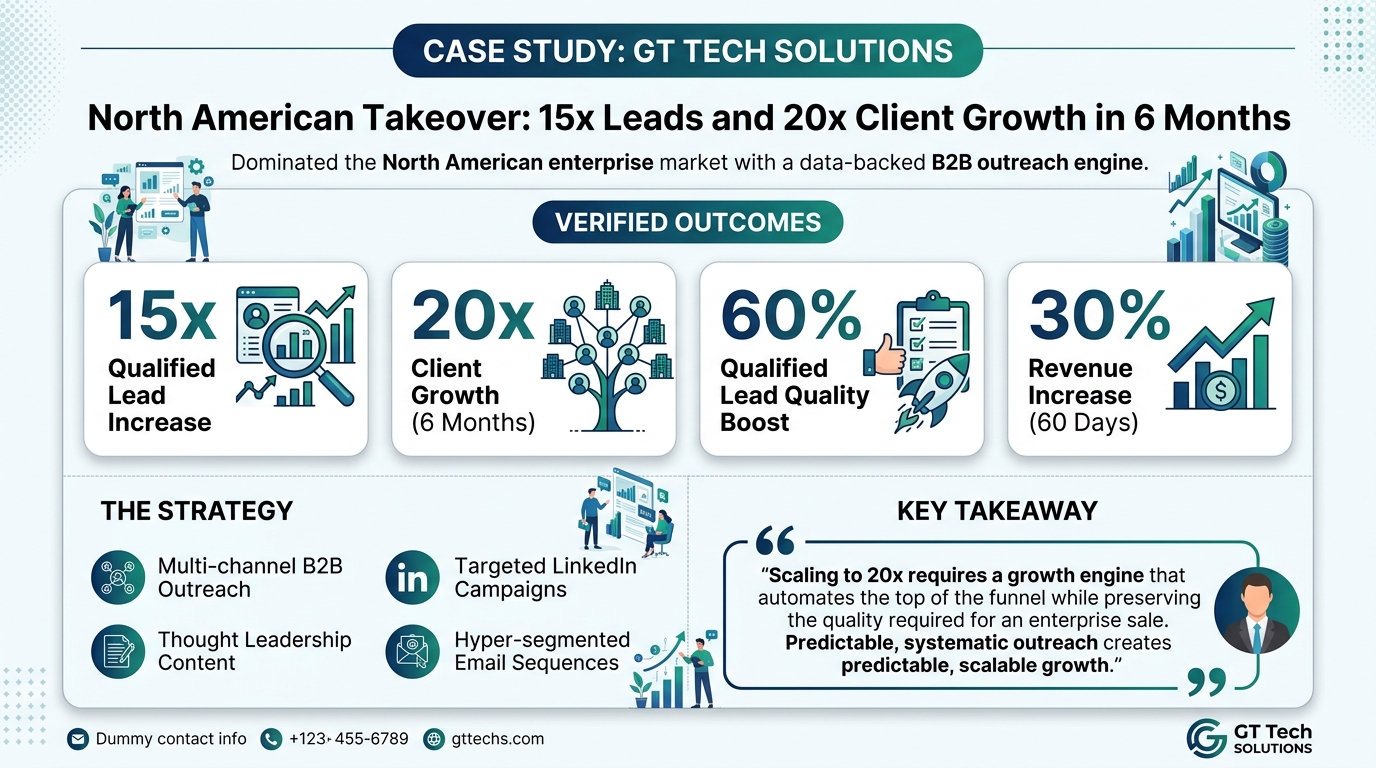
Verified Outcomes
The Brief
Engagement summary at a glance.
- Client
- GT Tech Solutions (enterprise tech vendor · North America expansion)
- Engagement
- 6-month North America growth engagement
- Industry
- Enterprise Technology
- ICP definition for NA enterprise tech buyers
- Persona-segmented multi-channel outbound
- Thought-leadership content + LinkedIn amplification
- Hyper-segmented email sequencing
- Pipeline + revenue dashboard with attribution
The Context
What was happening before we stepped in.
GT Tech Solutions had a powerful, proven enterprise product but virtually zero brand awareness in the highly saturated North American technology market. They were growing steadily in their home market but couldn't achieve the explosive growth trajectory their technology and ambition deserved.
The Problem
The friction we identified and eliminated.
Previous cold outreach attempts generated a trickle of leads that consistently failed to convert. The product was positioned too generically — failing to communicate specific value to the enterprise buyers who could actually champion a purchase. Without the right narrative and targeting precision, even superior technology goes unnoticed.
Our Solution
The strategic and technical intervention.
We launched a multi-channel B2B marketing takeover targeting North American enterprise buyers. Combining high-intent LinkedIn outreach, thought leadership content positioning GT Tech as a trusted authority, and hyper-segmented email sequences tailored to specific buyer personas and industries — we generated both massive inbound interest and a structured outbound pipeline.
Implementation Summary
Ran a comprehensive B2B lead generation and positioning campaign targeting North American enterprise buyers across LinkedIn, email, and content channels.
Our Approach
The phased methodology, in order.
- 01
Re-positioned away from 'enterprise tech generalist'
GT Tech's prior pitch was the classic enterprise-tech trap: 'we do everything for everyone.' We narrowed the positioning to the two verticals where their delivery track record was strongest — financial services and large-enterprise tech ops — and rewrote the entire narrative around the specific operational pain those buyers face. The pipeline grew because the message finally meant something to the person reading it.
- 02
Built persona-segmented messaging for NA enterprise
Three personas, three message arcs, three sequence styles. The CIO message led with strategic posture and risk reduction; the VP-of-Engineering message led with delivery velocity and technical depth; the Procurement message led with vendor-management and SLA terms. Same product, three different doors — and reply rates climbed because each buyer felt the message was for them, not for everyone.
- 03
Layered thought-leadership content for inbound multiplier
We shipped a tight LinkedIn + long-form content cadence positioning GT Tech founders as opinionated voices in their two chosen verticals — not vendor blogs, real takes on enterprise delivery and risk. The content opened doors that cold outreach couldn't, and inbound velocity from the named-account list grew measurably each month.
- 04
Hyper-segmented email sequences against the named-account list
We mined the named-account list for buying signals — recent leadership changes, public RFPs, technology announcements, hiring patterns — and segmented the email sequences against those signals. Generic sequences went out to nobody; every prospect got a sequence triggered by something visible about their company that quarter.
- 05
Wired attribution into a single revenue dashboard
The leadership team needed to see, in one view, what was actually driving the 20x client growth. We built a HubSpot-linked dashboard that attributed every closed deal to its first-touch + multi-touch contribution — content, sequence, persona, signal — so the team could double down on what was actually working instead of guessing.
What We Built
The artefacts shipped during the engagement.
Sharper positioning for two verticals
Re-narrated GT Tech's GTM around financial services and enterprise tech ops — the two segments with the strongest delivery track record.
Three-persona outbound architecture
CIO, VP-Engineering, and Procurement personas each with their own message arc, sequence style, and proof points.
Thought-leadership content engine
LinkedIn + long-form cadence positioning the founders as opinionated voices, amplified through targeted ads against named accounts.
Signal-segmented email sequences
Sequences triggered by recent leadership changes, public RFPs, tech announcements, and hiring patterns — never generic.
Revenue attribution dashboard
Single-pane view of multi-touch attribution across content, sequence, persona, and signal — so leadership can double down on what's actually driving close.
Measurable Outcomes
Qualified-lead volume grew 15x compared to the prior baseline. Critically, the volume came alongside a 60% lift in lead quality — these weren't more leads from a broader funnel, they were more leads from a tighter, better-engineered funnel.
Total client count grew 20x in six months. The expansion was concentrated in the two chosen verticals, validating the positioning thesis and giving the team a reference base to scale into adjacent verticals next.
Lead quality — measured as the percentage of leads that progressed past first qualification — lifted 60%. The persona-segmented + signal-triggered approach means the engine is reaching prospects who are actually in a buying window, not just anyone who matches a job title.
Revenue grew 30% in the first 60 days alone — driven by faster close cycles on engine-sourced opportunities and expansion within early reference accounts. The compounding effect over the full six months produced the 20x client-growth headline.
The Stack
Project Timeline
- Mo 01
Repositioning + ICP
Re-narrated around financial services + enterprise tech ops; named-account list locked.
- Mo 02
Persona + sequence build
Three personas + signal-segmented sequences live; first thought-leadership content shipped.
- Mo 03
First wave of wins
First named-account meetings booked; first deals closed in financial-services segment; revenue grew 30% in 60 days.
- Mo 04
Content amplification
LinkedIn ad amplification layered onto content cadence; inbound velocity from named accounts grew measurably each month.
- Mo 05
Scale across verticals
Expanded into adjacent enterprise verticals on the back of reference accounts; 15x qualified-lead lift achieved.
- Mo 06
Steady-state
20x client growth realised; predictable monthly pipeline contribution; engagement transitioned to a steady-state retainer.
“We were great at delivery and bad at being known for it. Six months in, we've gone from chasing leads to choosing which deals to take — and the dashboard tells us exactly why every one of them closed.”
Key Takeaway
“Scaling to 20x requires a growth engine that automates the top of the funnel while preserving the quality required for an enterprise sale. Predictable, systematic outreach creates predictable, scalable growth.”
Frequently asked, about this engagement.
Why does narrowing positioning to two verticals produce 15x more leads, not less?
Counter-intuitive but consistent across our enterprise engagements. When the message is generic, every prospect deflects with 'this isn't really for us.' When the message is sharply tuned for a vertical, the buyers in that vertical lean in, the buyers outside it self-select out, and your pipeline gets denser, not thinner. We've seen the same pattern at Texas SaaS, Extensis HR, and ToothLens.
How does signal-triggered sequencing work in practice?
We track public buying signals against the named-account list — leadership changes, RFP postings, hiring spikes, technology announcements — and trigger personalised sequences within hours of a signal firing. The buyer reads the message in the context of something they're actively dealing with that week, which makes the message land instead of getting filtered.
Does this engine work for non-North-American enterprise markets?
Yes. The same persona-segmented + signal-triggered architecture runs cleanly across UK, EU, Indian, and GCC enterprise markets. The signal sources change (different RFP databases, different hiring data, different press patterns) but the discipline is identical.
What does an engagement of this size cost?
$10K–$25K/month for a comparable 6-month enterprise growth engagement, depending on geography, segment count, and whether content amplification is included. The engine typically pays back inside the first 90 days on enterprise-tech ACVs.
Related solutions
AI SDR Replacement for B2B SaaS
Most B2B SaaS SDR teams cost $1,000–$1,500 per booked meeting and lose 30–50% of their hires inside 12 months. We replace the entire layer with a persona-driven AI sales engine that books better-qualified meetings at a third of the cost — and we've shipped it for Texas SaaS, GT Tech, and Nimit AI.
Custom CRM for Indian Startups
Most Indian startups try to fit into HubSpot or Salesforce and break. Their actual sales motion is WhatsApp-first, founder-led, and runs on real-time buying signals — not enterprise pipeline stages. We build custom CRMs that match how Indian startups actually sell, at a fraction of the SaaS sticker.
Want results like GT Tech Solutions?
Book a free 30-minute call. We'll map exactly what to build, what to skip, and what it should cost for your business.