
Appointment setting vs lead generation: they are not the same thing
Every week, a founder asks us: "Do I need lead generation or appointment setting?" The answer matters because buying the wrong one wastes 3–6 months of budget. Here is the actual difference, when each makes sense, and what the economics look like in 2026 for B2B sales teams in India and the US.
What is B2B appointment setting?
Appointment setting is a narrow, high-value service: someone (human or AI) prospects into your ICP, runs outreach sequences, handles replies, qualifies interest, and books a meeting directly on your closer's calendar. You pay for meetings, not leads.
The output is a calendar invite with a qualified prospect who has agreed to a specific time. Your AE or founder shows up and sells. Everything upstream — list building, copy, domains, deliverability, follow-ups, reply handling — is the appointment setter's problem.
Typical channels: cold email, LinkedIn outreach, and sometimes cold calling. The motion is outbound-first.
Who should buy appointment setting:
- Sales teams with closers who don't have enough at-bats
- Founders who can close but don't have time to prospect
- Companies with a proven offer and clear ICP, just need more pipeline volume
- Teams that want a predictable cost-per-meeting metric
What is B2B lead generation?
Lead generation is broader. It covers every channel and tactic that puts qualified prospects into your funnel — not just booked meetings, but MQLs, SQLs, inbound inquiries, webinar registrants, content downloads, and partner referrals.
A lead generation agency typically works across 5–9 channels: cold email, LinkedIn, SEO, paid ads (Google/LinkedIn), webinars, community engagement, content marketing, founder outreach, and partner/referral programs.
The output is pipeline measured in your CRM: opportunities created, pipeline value, and revenue influenced. Some of those leads are booked meetings; many are not.
Who should buy lead generation:
- Companies that need to build a sustainable, multi-channel growth engine
- Teams where outbound alone isn't enough volume for their growth targets
- Businesses entering a new market (e.g., Indian agency expanding to US clients)
- Companies with longer sales cycles (3–9 months) that need nurture across touchpoints
The real differences: a side-by-side comparison
| Dimension | Appointment Setting | Lead Generation |
|---|---|---|
| Primary output | Booked meetings on your calendar | Pipeline: MQLs, SQLs, opportunities, revenue |
| Channels | Cold email, LinkedIn, cold calling | Email, LinkedIn, SEO, paid, webinars, content, partners |
| Pricing model | Per-meeting or monthly retainer | Monthly retainer tied to channel mix |
| Typical cost (India) | $800–$3,600/month | $2,000–$8,000/month |
| Typical cost (US) | $2,000–$8,000/month | $5,000–$20,000/month |
| Time to first result | 3–4 weeks | 4–12 weeks (varies by channel) |
| Best for | Teams with closers, need meetings now | Teams building long-term growth engine |
| Risk | Single-channel dependency | Higher upfront cost, slower initial ROI |
When you need appointment setting (not lead gen)
Buy appointment setting when three conditions are true:
- Your offer is proven. You have case studies, a clear price point, and a repeatable close process. You don't need to "figure out the market" — you need more at-bats.
- Your sales cycle is short. Under 90 days from first meeting to close. If your cycle is 6+ months, a single booked meeting isn't the bottleneck — nurture is.
- You have closers ready. An AE, founder, or sales lead who can take 15–25 meetings per month and convert them. Appointment setting without closing capacity is wasted budget.
At Digital Patron, our B2B appointment setting service delivers 18–24 qualified meetings per month using an AI SDR stack at $800–$3,600/month. The AI handles list building, outreach, follow-ups, and booking; your team handles closing.
When you need lead generation (not just meetings)
Buy lead generation when:
- Outbound alone can't hit your growth target. Most B2B companies plateau at 20–30 outbound meetings/month. If you need 50+ opportunities, you need inbound, SEO, paid, and partnerships feeding the funnel alongside outbound.
- You're entering a new market. Indian agencies expanding to the US, or SaaS companies launching in EMEA, need brand awareness + demand gen + outbound working together.
- Your sales cycle is long. Enterprise deals with 6–12 month cycles need content, retargeting, webinars, and multi-touch nurture — not just a cold email that books one meeting.
Our multi-channel lead generation service runs 9 channels as one coordinated engine: cold email, LinkedIn, AI SDR, SEO, paid ads, founder outreach, webinars, communities, and partner referrals.
The hybrid approach: appointment setting powered by lead generation
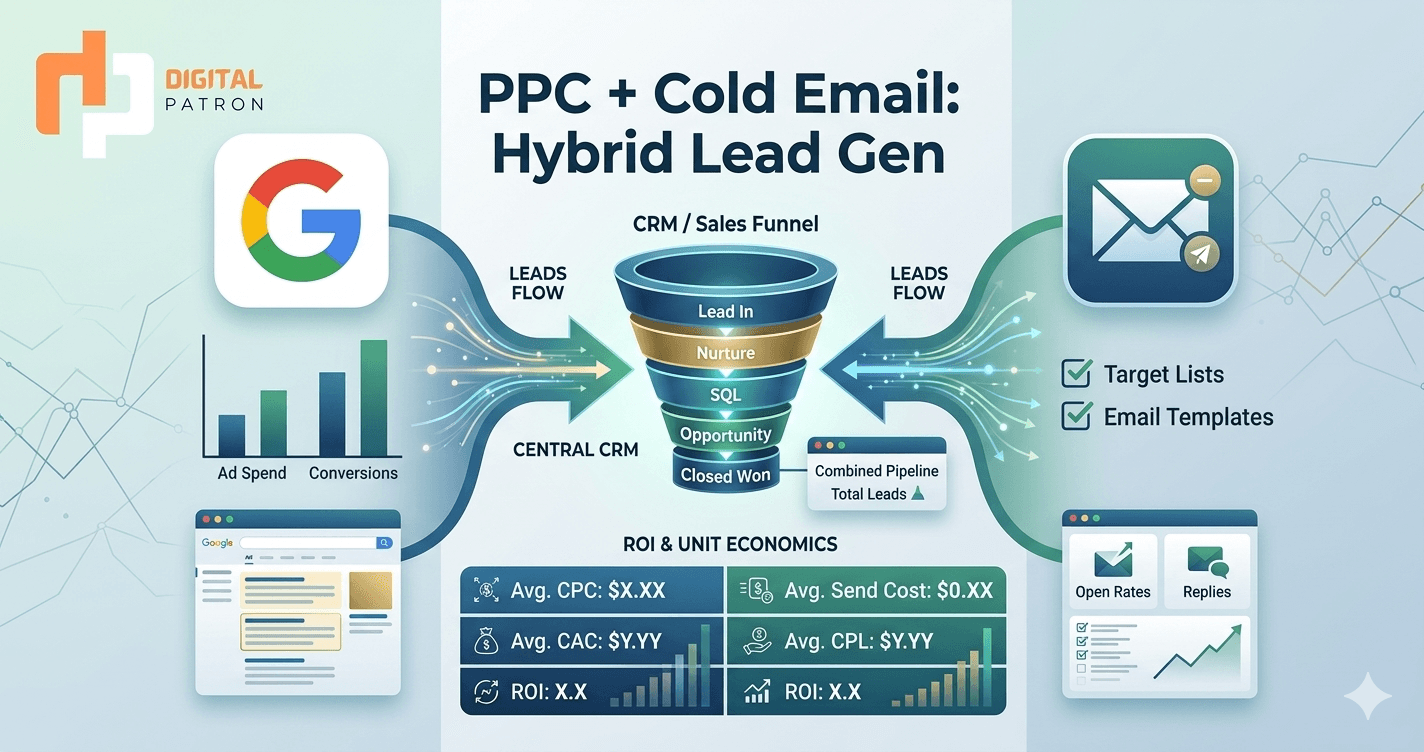
Most B2B teams in 2026 need both — and the smartest agencies run them as one system. Here's how it works at Digital Patron:
- Month 1–3: Appointment setting via cold email and LinkedIn delivers immediate pipeline (18–24 meetings/month). This pays for itself while slower channels ramp.
- Month 2–4: SEO content starts ranking, building inbound lead flow that supplements outbound.
- Month 3–6: Paid ads, webinars, and community engagement add volume. Total pipeline grows from 20 meetings/month to 40+.
- Month 6+: Compounding effect — inbound leads warm up cold prospects, brand recognition improves cold email reply rates, SEO compounds.
The companies that grow fastest in B2B SaaS in 2026 don't choose between appointment setting and lead generation. They start with appointment setting for immediate ROI and layer lead generation for compounding growth.
How to evaluate an appointment setting or lead generation agency
Whether you're buying meetings or pipeline, ask these five questions before signing:
- What's the cost per meeting (or cost per SQL)? If the agency can't give you a number, they don't have enough data. Good agencies track this obsessively.
- Who owns the domains and data? You should own your sending domains and prospect data. Agencies that hold these hostage create switching costs.
- What's the ramp timeline? Honest answer: 3–4 weeks for first meetings (appointment setting), 8–12 weeks for multi-channel pipeline (lead gen). Anyone promising day-one results is sending from unwarmed infrastructure.
- Do they use AI SDRs or human SDRs? In 2026, the best agencies use AI SDR stacks for volume and humans for qualification. Pure-human shops are expensive; pure-AI shops miss nuance.
- Can they show you real client data? Anonymised is fine. But ask for meeting volumes, reply rates, and cost-per-meeting from a comparable ICP. Our case studies show exactly this.
Frequently asked questions
Is appointment setting part of lead generation?
Yes — appointment setting is a subset of lead generation. Lead generation is the umbrella that includes every channel bringing prospects into your funnel. Appointment setting is the specific tactic of booking qualified meetings through outbound outreach. Every appointment-setting campaign is lead generation, but not all lead generation is appointment setting.
What's the average cost per meeting for B2B appointment setting in 2026?
In India, expect $150–$500 per booked meeting through an agency (depending on ICP difficulty and channel). In the US, the range is $300–$1,200 per meeting. AI-powered appointment setting (like Digital Patron's) typically runs 40–60% cheaper than human-only approaches — our Gurgaon SaaS client hit $350/meeting vs $1,200/meeting with human SDRs.
Can I do appointment setting in-house instead of hiring an agency?
Yes, but the infrastructure cost is often underestimated. You need: sending domains ($50–$100/month), warmup tools ($50–$100/month), a cold email platform like Instantly or Smartlead ($94–$174/month), data enrichment ($150–$500/month), and at least one person managing it (SDR salary: ₹8.5L/year in India, $65K/year in the US). Total in-house cost often exceeds agency cost for companies under 50 employees.
What's the difference between appointment setting and demand generation?
Demand generation creates awareness and interest in your category (top-of-funnel). Appointment setting converts existing interest or cold prospects into meetings (mid-funnel). Demand gen makes people want what you sell; appointment setting gets them on the phone. B2B companies need both, but at different stages — early-stage companies with a proven offer should start with appointment setting for immediate pipeline.
Should Indian agencies offering US services buy appointment setting or lead generation?
Start with appointment setting to prove the US market responds to your offer. Our playbook for getting US clients from India details the 90-day approach. Once you've closed 3–5 US clients and have case studies, invest in lead generation (especially SEO and LinkedIn content) to build inbound alongside outbound.
Bottom line
Appointment setting gives you meetings now. Lead generation builds the engine that compounds over 6–12 months. The right choice depends on your stage, sales cycle, and growth targets — not on which vendor has the better pitch deck.
If you're not sure which you need, book a free 30-minute call. We'll look at your current pipeline, ICP, and growth targets and recommend honestly — even if the answer is "do it yourself for now."