
Full-Stack Web & Mobile Platform for Hotel Marketing with Real-Time Sync
A scalable web and Android platform enabling hotel brands to collaborate, access real-time digital solutions, and manage marketing workflows from a single source of truth.
Verified Outcomes
The Brief
Engagement summary at a glance.
- Client
- The Hotel Media (hotel marketing platform · global)
- Engagement
- 16-week build, then maintenance + feature retainer
- Industry
- Hospitality & Hotel Marketing
- Full-stack web platform (admin + partner views)
- Native Android app for field teams
- Real-time sync engine across web and mobile
- Role-based collaboration module
- Asset management + campaign workflow
The Context
What was happening before we stepped in.
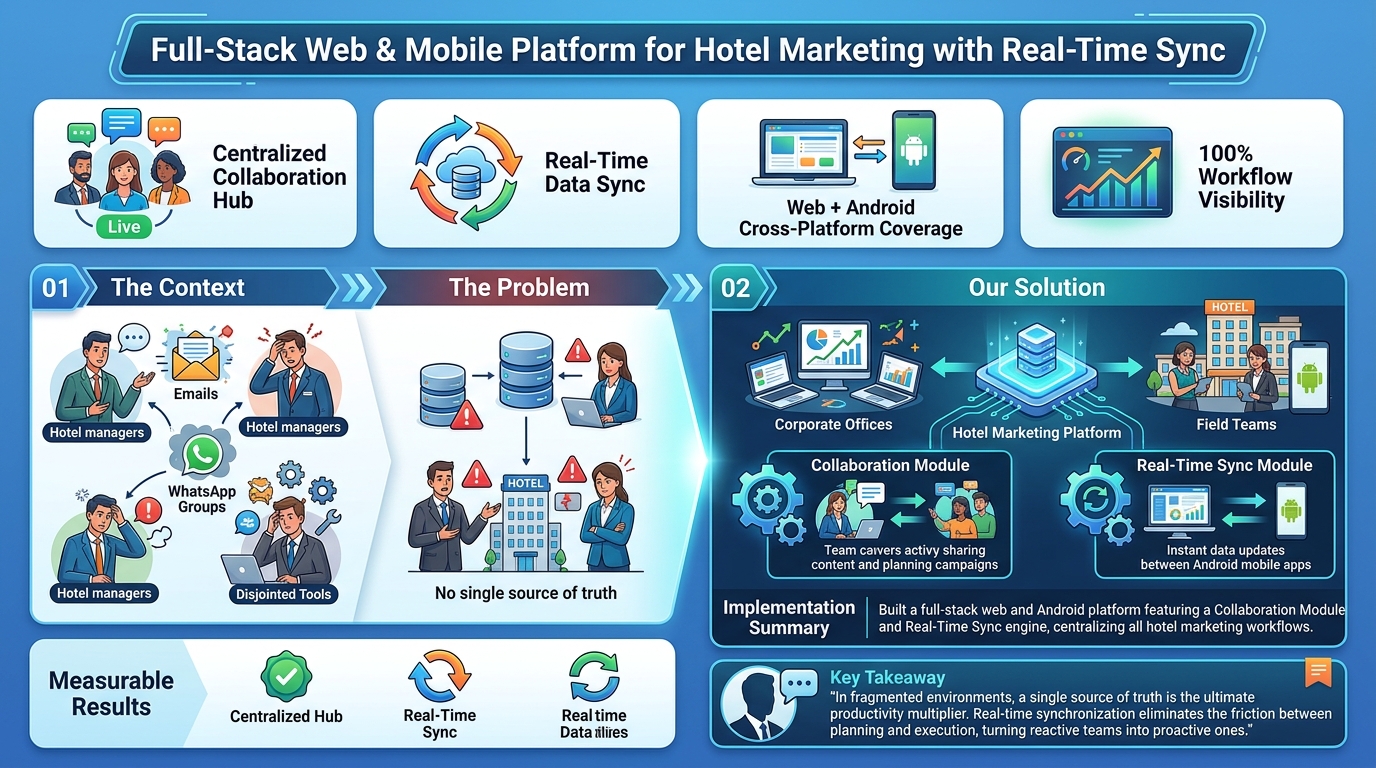
The Hotel Media operated in the high-velocity world of hotel marketing — managing workflows across web, iOS, and Android where 'real-time' data isn't a luxury, it's a requirement for survival. Marketing directors in corporate offices were fundamentally disconnected from field teams at actual hotel properties.
The Problem
The friction we identified and eliminated.
Coordination happened in silos, leading to decisions based on stale information, campaign delays, and frustrated hospitality partners. There was no single source of truth — just scattered emails, WhatsApp groups, and disjointed third-party tools that created costly miscommunications.
Our Solution
The strategic and technical intervention.
We built a scalable full-stack platform centered on two technical pillars. The Collaboration Module provides a unified interface bridging office and field roles — enabling hotel teams and partners to share content and coordinate campaigns. The Real-Time Sync Module delivers instant updates and live data synchronization across web and Android, ensuring every team member sees the same data simultaneously.
Implementation Summary
Built a full-stack web and Android platform featuring a Collaboration Module and Real-Time Sync engine, centralizing all hotel marketing workflows.
Our Approach
The phased methodology, in order.
- 01
Mapped every workflow before writing a line of code
We spent the first three weeks shadowing both the corporate marketing team and the on-property field teams. We documented every campaign hand-off — from brief approval to creative review to property-level execution — and identified where stale data was actually killing campaigns. That workflow audit became the spec.
- 02
Designed a single source of truth, not another dashboard
Our data model was built around the campaign as the atomic unit, not the user. Every asset, comment, approval, and status flag lives on the campaign object. This made conflict resolution between web and Android straightforward and turned cross-team coordination into a side effect of the schema rather than a process people had to remember.
- 03
Engineered the real-time sync layer first
Real-time was the non-negotiable, so we shipped the sync engine before the rest of the UI. Socket-based pub/sub on the server, last-writer-wins with optimistic UI on the client, and a clear conflict-resolution UI for the rare overlapping edits. By week six the team was already collaborating on test campaigns in two places at once.
- 04
Built web and Android against the same contract
The web app and the native Android app share the same API contract and the same real-time channel. We didn't build a 'mobile-lite' version — field teams get the full feature set, just optimised for handheld workflows like on-site capture, quick approvals, and offline draft mode for poor-connectivity properties.
- 05
Phased rollout with the corporate team first
We launched to corporate marketing only for the first three weeks, fixed every friction point that surfaced, then rolled out to a controlled set of pilot properties. By the time we opened the Android app to all field teams, the platform had already absorbed the worst edge cases on real campaigns.
What We Built
The artefacts shipped during the engagement.
Web admin + partner application
Full-stack web app with role-based views for corporate marketing, property managers, and external partners. Built on a typed API + reactive client.
Native Android app
Same data, mobile-first UX. Offline draft mode for low-connectivity properties, push notifications for approvals, and one-tap asset capture for field teams.
Real-time sync engine
Socket-based collaboration layer with optimistic UI, conflict resolution, and presence indicators so teams see who's editing what live.
Campaign workflow + approvals
Brief → asset upload → review → approval → property-level activation, with audit trail and SLA timers on every step.
Asset management library
Centralised media library with brand-safe folders, version history, and per-property tagging so field teams can find the right asset in seconds.
Reporting + activity feed
Per-campaign and per-property analytics, plus a global activity feed so directors can see at a glance what's moving and what's stuck.
Measurable Outcomes
Where there were once a dozen disconnected channels — email, WhatsApp, Drive folders, Slack, third-party trackers — there is now one source of truth. Every campaign, every asset, and every approval lives in one place that both corporate and field teams trust.
Updates from a property manager in the field appear instantly on the corporate marketing director's screen — no refreshes, no exports, no 'hey did you see my email?'. The team finally moves at the speed the hotel-marketing market demands.
Every role works in the surface that fits their job. Corporate works in the web app, field teams work in the Android app, and external partners get scoped web access. None of them lose features by switching platforms.
Every brief, asset, and approval has a clear owner and a clear status. The 'where is this?' question — once the most-asked question on every campaign — has effectively disappeared from the team's day-to-day.
The Stack
Project Timeline
- Wk 01–03
Workflow audit
Shadowed corporate + field teams, documented every campaign hand-off and friction point.
- Wk 04–06
Schema + sync engine
Data model locked around the campaign object; real-time sync engine live in staging.
- Wk 07–10
Web platform build
Role-based web app with collaboration, approvals, and asset library shipped to corporate users.
- Wk 11–13
Android app build
Native Android app with offline draft mode and push notifications shipped to pilot properties.
- Wk 14–15
Pilot rollout
Corporate live for two weeks, then a controlled rollout to a pilot cohort of properties.
- Wk 16+
Global rollout + retainer
Platform opened to all properties; ongoing retainer for new feature work and reliability tuning.
“Our corporate team and the people running campaigns at actual hotels finally work in the same place. The lag between an idea and execution went from days to minutes — and we can finally see what's stuck before it costs us a campaign.”
Key Takeaway
“In fragmented environments, a single source of truth is the ultimate productivity multiplier. Real-time synchronization eliminates the friction between planning and execution, turning reactive teams into proactive ones.”
Frequently asked, about this engagement.
How long does a hotel-marketing platform like this take to ship?
We typically ship a production-ready web + native mobile platform with real-time sync in 14–18 weeks. The Hotel Media build was 16 weeks end-to-end, with the corporate web app live by week 10 and the Android app live by week 13.
Why a native Android app and not just a responsive web build?
Field teams at hotel properties operate in environments with poor connectivity, frequent role-switching, and the need for quick on-site capture. Native gives us reliable offline mode, fast push notifications for approval routing, and one-tap camera/upload flows that a web build can't match.
What does it cost to build something similar?
A multi-tenant hospitality platform with web + native mobile + real-time sync typically lands in the ₹15–₹40 lakh range depending on the depth of role-based permissions, third-party integrations (PMS, channel manager, OTA), and how rich the analytics layer needs to be.
Do you only build for hotel chains, or also for boutique groups?
Both. The same architecture scales down to a 4–10 property boutique group and up to a global chain. Boutique groups usually skip the deep PMS integrations and focus on collaboration + asset management; chains layer in approvals, channel-manager sync, and per-region governance.
Related solutions
Want results like The Hotel Media?
Book a free 30-minute call. We'll map exactly what to build, what to skip, and what it should cost for your business.