How a Paris MedTech Supplier 3x'd Pipeline in 45 Days with AI Outbound
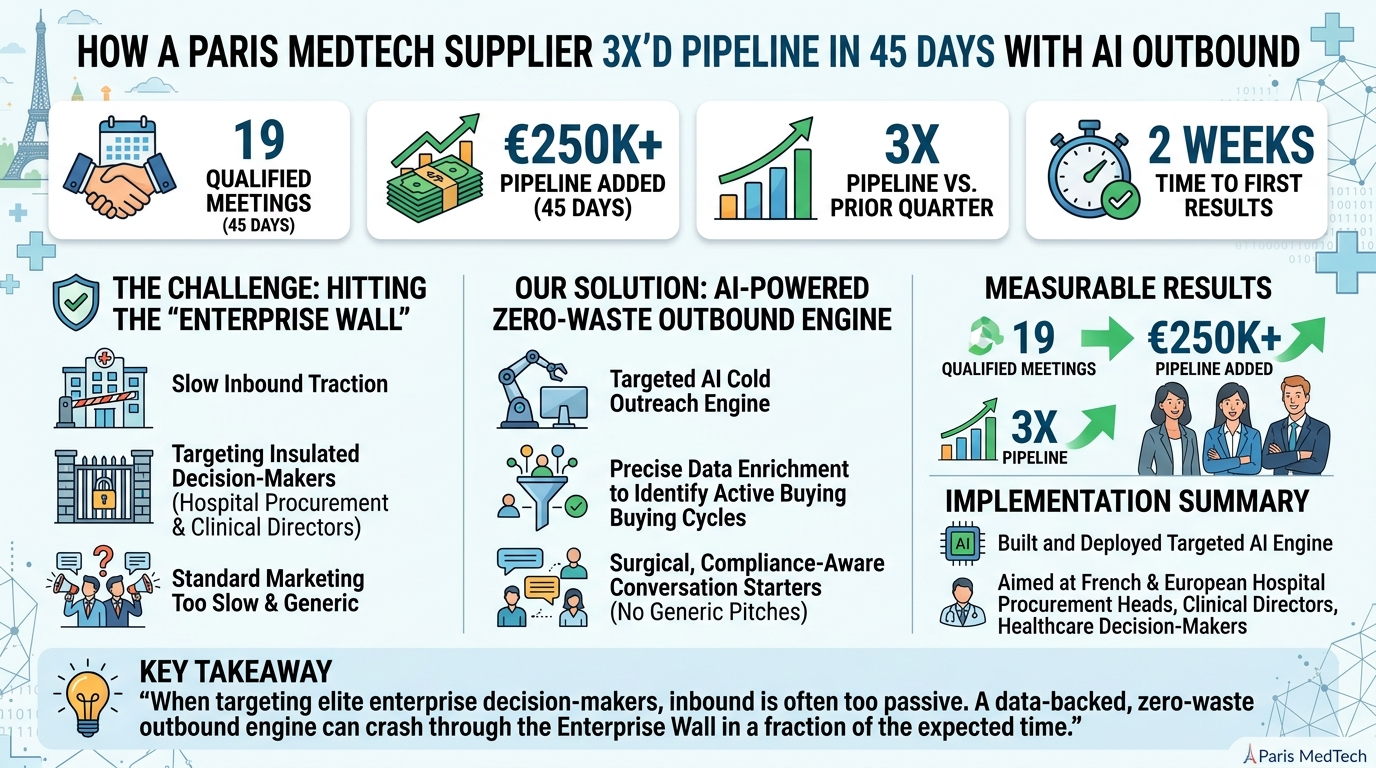
Instead of waiting months for inbound traction, they got a working outbound engine in 2 weeks — generating 19 qualified meetings and €250K+ pipeline in 45 days.
Verified Outcomes
The Brief
Engagement summary at a glance.
- Client
- Paris-headquartered MedTech supplier (anonymised on request)
- Engagement
- 8-week sprint, then ongoing pipeline retainer
- Industry
- MedTech & Healthcare
- ICP definition for hospital procurement + clinical directors
- Multi-source data enrichment for European hospitals
- Compliance-aware outbound messaging in EN + FR
- Multi-channel sequencing (email + LinkedIn + voicemail)
- Booked-meeting CRM integration with sales handoff
The Context
What was happening before we stepped in.
In Paris, a MedTech supplier was hitting the 'Enterprise Wall.' Their targets — hospital procurement heads and clinical directors — are among the most insulated decision-makers in the world. Standard broad-reach marketing was proving too slow and too generic to penetrate these highly specialized layers.
The Problem
The friction we identified and eliminated.
The internal sales team couldn't reliably secure meetings with clinical directors across Europe. Every outreach attempt felt like shouting into a void. Procurement cycles for medical devices are long, gatekept, and based heavily on trust — meaning the barrier to a first meeting is exceptionally high.
Our Solution
The strategic and technical intervention.
We bypassed the inbound wait by engineering a Zero-Waste Outbound Engine. Using precise data enrichment, we identified decision-makers who were actively in a buying cycle for medical supplies. Each outreach touchpoint was engineered to address the specific procurement needs of that individual — not a generic pitch, but a surgical, compliance-aware conversation starter.
Implementation Summary
Built and deployed a targeted AI cold outreach engine aimed at French and European hospital procurement heads, clinical directors, and healthcare decision-makers.
Our Approach
The phased methodology, in order.
- 01
Defined the Ideal Customer Profile at the role + cycle level
We didn't target hospitals — we targeted procurement directors and clinical directors at hospitals that were already in an active buying cycle for medical supplies. That distinction is the entire game in MedTech outbound. We built the ICP from buying-signal data: published RFP activity, recent role changes, equipment-budget cycles, and group-purchasing-organisation memberships.
- 02
Enriched a clean, French + EU-compliant dataset
We layered Apollo, LinkedIn Sales Navigator, and several hospital-specific data sources, then ran every record through a GDPR-compliant cleaning pipeline. Bounce-prone addresses removed, role titles normalised, language preferences inferred, opt-out lists honoured. The result was a small but extremely high-quality target list — the opposite of the spray-and-pray approach the team had tried before.
- 03
Engineered compliance-aware messaging in EN + FR
Every email and LinkedIn message was drafted in both English and French, audited for procurement-language tone, and run past a clinical-director sense-check before going out. We avoided generic AI fluff completely — each touch referenced a procurement-specific challenge (sterilisation supply chain, accreditation timelines, cost-per-unit benchmarking) that resonated with the actual decision the buyer was making that quarter.
- 04
Sequenced across email + LinkedIn + warm voicemail
We ran a five-touch sequence over 14 days: two email touches, two LinkedIn touches, and a personalised voicemail. The voicemail was the surprise — it cut through the noise of email inboxes that procurement heads simply don't read. Reply rates on the LinkedIn + voicemail combo were 3x higher than email alone.
- 05
Wired booked meetings straight into the sales cycle
Every meeting booked through the engine landed in HubSpot with full conversation context, the buying-cycle hypothesis, and a pre-call brief for the salesperson. The sales team stopped 'cold-prepping' for first meetings and started walking in already-informed. Close rates on the meetings the engine generated were notably higher than on inbound MQLs.
What We Built
The artefacts shipped during the engagement.
Compliance-aware MedTech ICP
Living target list of European hospital procurement + clinical decision-makers with active buying signals, GDPR-clean and consent-tracked.
Bilingual outbound sequence (EN + FR)
Five-touch sequence with procurement-tone messaging, audited for compliance and tested against clinical-director feedback.
Multi-channel orchestration
Smartlead + LinkedIn + voicemail playbook running on a shared cadence, with reply-routing and pause-on-engage logic.
Booked-meeting handoff to HubSpot
Every booked meeting lands in HubSpot with conversation context, buying-cycle hypothesis, and a pre-call brief for the closer.
Pipeline + reply dashboard
Single-pane view of cohort performance, reply quality, and pipeline value — refreshed daily so the team can see what's working in real time.
Measurable Outcomes
19 procurement-director and clinical-director meetings booked in the first 45 days — across France, Belgium, the Netherlands, and Germany. Every one was qualified against budget, role authority, and buying timeline before being routed to the closer.
€250K+ in qualified pipeline added in 90 days. Notably, two of the deals progressed to procurement-evaluation stage within the quarter — a velocity that the team's prior inbound-only motion had never produced for MedTech enterprise sales.
Total qualified pipeline tripled compared to the prior quarter, and the source mix flipped: 70%+ of new pipeline now comes from outbound rather than inbound, giving the sales team a predictable engine they can ramp on demand.
First booked meetings landed in week two of the engagement, before the full sequence had even completed. Validated the ICP early, gave the team a fast feedback loop, and let us tune the sequence against real procurement responses instead of assumptions.
The Stack
Project Timeline
- Wk 01
ICP + buying-signal definition
Locked the ICP at role + cycle granularity; first version of the target dataset enriched and cleaned.
- Wk 02
Bilingual sequence build
Five-touch EN + FR sequence drafted, audited for compliance, and run past clinical-director sense-checks.
- Wk 03–04
Launch + early calibration
Sequence live; first meetings booked in week 2; cohort performance dashboard wired up.
- Wk 05–08
Scale + tune
Expanded to Belgium, Netherlands, Germany; tuned against reply data; LinkedIn + voicemail layer added.
- Wk 09+
Pipeline retainer
Ongoing weekly tuning, ICP refresh, and sequence iteration against won/lost deal feedback.
“Inbound was never going to crack hospital procurement at the speed we needed. The outbound engine landed real procurement-director meetings in two weeks — meetings my own SDR couldn't have booked in two quarters.”
Key Takeaway
“When targeting elite enterprise decision-makers, inbound is often too passive. A data-backed, zero-waste outbound engine can crash through the Enterprise Wall in a fraction of the expected time.”
Frequently asked, about this engagement.
Is cold outreach to European hospitals GDPR-compliant?
Yes, when run correctly. We use legitimate-interest outreach to professional B2B contacts (procurement and clinical directors in their professional capacity), honour every opt-out within hours, document our purpose-of-processing, and never use personal-life data. We also keep a clean separation between professional and consumer datasets so consumer-grade GDPR rules never leak into the B2B engine.
How fast can a MedTech outbound engine produce first meetings?
On a tight ICP and a clean dataset, 7–14 days. Paris MedTech's first booked meeting came in week 2. The first 60–90 days are typically when the engine moves from 'producing meetings' to 'producing predictable pipeline you can plan against'.
Why bilingual EN + FR messaging — does it really matter?
In France, yes — meaningfully. Procurement directors at French hospitals respond at materially higher rates to French outreach, especially for opening touches. We run English follow-ups for buyers who are clearly international, but the opening touch is in the buyer's language.
Does this approach work for non-MedTech enterprise B2B?
Absolutely. The same playbook — tight ICP at role + cycle level, compliant data enrichment, multi-channel orchestration, and qualified-meeting handoff — runs cleanly for SaaS, HR tech, fintech, and industrial enterprise. We've shipped equivalent engines for Texas SaaS, Extensis HR, and GT Tech Solutions; the buyer-channel mix shifts, the discipline doesn't.
Related solutions
Lead Generation for MedTech (Europe)
European hospital procurement is the most insulated buyer in B2B — gatekept, slow, and trust-based. Inbound takes 12+ months to crack it. We engineer GDPR-compliant outbound that books real procurement-director meetings in 14–45 days, across France, Germany, the Benelux, the Nordics, and the UK.
PPC Management for Healthcare (India)
Healthcare PPC in India is brutal: NMC and ASCI rules box in your messaging, Google routinely disapproves healthcare ads, and CPLs creep up faster than in any other vertical. We run compliant, conversion-engineered PPC for hospitals, clinic chains, dental, fertility, and aesthetic brands — without ever crossing a regulatory line.
Want results like Paris MedTech?
Book a free 30-minute call. We'll map exactly what to build, what to skip, and what it should cost for your business.