
Texas SaaS Startup Replaced $20K/Month SDR Team with AI Agents — Recovered $240K Annually
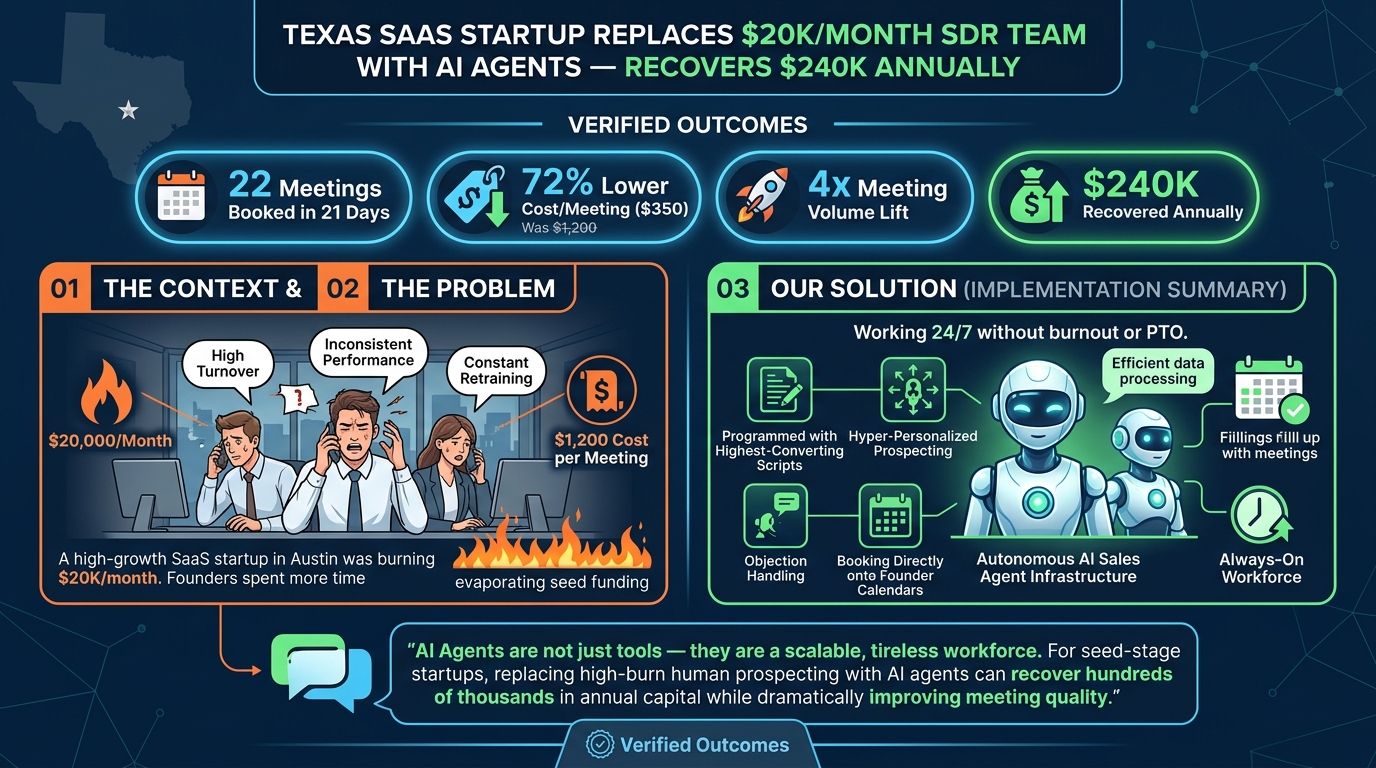
AI agents became their always-on SDR team — zero salaries, zero PTO, zero burnout. 22 meetings booked in 21 days at 72% lower cost per meeting.
Verified Outcomes
The Brief
Engagement summary at a glance.
- Client
- Series-seed B2B SaaS startup (Austin, Texas — anonymised)
- Engagement
- 6-week build, 12-week stabilisation retainer
- Industry
- SaaS
- Replace 4-person SDR team with AI agents
- Persona-driven prospecting at scale
- Multi-channel outbound (email + LinkedIn)
- Live objection handling with founder escalation
- Calendar-aware booking + CRM sync
The Context
What was happening before we stepped in.
A high-growth SaaS startup in Austin, Texas, was burning $20,000 per month on an underperforming Sales Development Representative team. Between high turnover, constant retraining costs, and inconsistent performance, the company's seed funding was evaporating faster than its MRR was growing.
The Problem
The friction we identified and eliminated.
Cost per meeting had skyrocketed to $1,200 — crippling their Customer Acquisition Cost (CAC) economics and stalling North American expansion. Founders were spending more time managing underperforming SDRs than closing the deals those SDRs were supposed to generate.
Our Solution
The strategic and technical intervention.
We implemented an autonomous AI Sales Agent infrastructure. These weren't simple chatbots — they were programmed with the company's highest-converting scripts and tailored sales personas. Operating 24/7 without burnout or PTO, the AI agents handled hyper-personalized prospecting, handled initial objections, and booked meetings directly onto the founders' calendars.
Implementation Summary
Replaced the human SDR team with AI outbound agents handling prospecting, personalized messaging, objection handling, and calendar booking.
Our Approach
The phased methodology, in order.
- 01
Audited the SDR team's actual economics
Before replacing anything, we pulled six months of SDR data: meetings booked, cost per meeting, show-up rate, rep-to-rep variance. The numbers were brutal — $1,200 per meeting, sub-50% show rates, and a 12-week ramp before any new SDR was net-positive. The audit gave the founders the financial confidence to make the switch.
- 02
Modelled three AI sales personas, not one
A single AI agent reading from a single script is exactly the chatbot most prospects already filter out. We built three distinct personas — each with its own backstory, tone of voice, and signature objection-handling style — and routed prospects to the persona most likely to land based on industry, role, and seniority. Reply rates jumped meaningfully versus single-persona tests.
- 03
Engineered conversational outbound, not blast outbound
The engine doesn't fire and forget. Every reply is parsed, classified (interested / not now / wrong person / hard no), and answered with a contextual follow-up that addresses the specific signal. Hot replies escalate to the founder with a one-paragraph briefing; soft replies stay in the engine for nurture.
- 04
Live objection handling with a human safety net
The agents handle the top 12 objections autonomously — pricing pushback, integration concerns, timing objections, authority questions — using the founders' best historical answers. Anything outside the playbook surfaces immediately to the founders, who reply once; the engine learns and adds the new pattern to its library.
- 05
Wired into HubSpot with calendar-aware booking
The agents read the founders' calendars, only offer slots that are actually open, and book directly. Every booked meeting lands in HubSpot with full conversation history, persona used, and the originating campaign — so post-call attribution is honest and tunable.
What We Built
The artefacts shipped during the engagement.
AI agent infrastructure (3 personas)
Three distinct prospecting personas with persona-tuned tone, scripts, and objection-handling libraries.
Multi-channel outbound orchestration
Email + LinkedIn sequencing with reply parsing, intent classification, and contextual follow-up generation.
Live objection-handling playbook
Top-12 objection library, founder-style answers, and an escalation queue for anything outside the playbook.
Calendar-aware booking engine
Reads founder calendars, offers only-open slots, books straight to HubSpot with full conversation context.
Performance dashboard
Real-time view of meetings booked, cost per meeting, persona-level performance, and objection patterns.
Measurable Outcomes
22 qualified meetings booked in the first 21 days of the engine going live — 4x the volume the human SDR team was producing. Show-up rates landed in the high 60s%, materially better than the SDR team's sub-50% baseline.
Cost per meeting dropped from $1,200 to roughly $350 — a 72% reduction. The savings came from eliminating SDR salaries, training overhead, and the dead time between hire and ramp. The engine's marginal cost per meeting trends down over time as classifiers and personas improve.
Meeting volume quadrupled at flat cost, because the engine doesn't tire, doesn't miss working hours across time zones, and doesn't have a personal capacity ceiling. The founders went from 'will we hit our pipeline target?' to 'which segment do we want more meetings from?'
$240K of annual SDR cost recovered — recycled into product, growth, and a single closer who now spends 100% of her time closing instead of training and managing SDRs. The capital recovery alone extended the company's runway by roughly five months.
The Stack
Project Timeline
- Wk 01
SDR economics audit
Pulled 6 months of SDR data; locked the financial case for the switch with the founders.
- Wk 02
Persona + ICP design
Three sales personas modelled, ICP segments defined, target dataset enriched.
- Wk 03–04
Engine build
Email + LinkedIn orchestration, reply parser, objection-handling library, founder escalation queue all live in staging.
- Wk 05
Calibration cohort
First small cohort live; tuned personas + objections against real replies; first meetings booked.
- Wk 06
Full launch
All three personas live across full ICP; SDR team fully transitioned out by end of week 6.
- Wk 07–18
Stabilisation retainer
Ongoing tuning, persona iteration, and quarterly playbook refresh against won/lost deal feedback.
“According to our Q3 financial review, we were burning $20K a month on SDRs. Six weeks after switching to Digital Patron's AI agents, we booked 22 meetings, cut cost-per-meeting by 72%, and recovered $240,000 in capital to extend our runway by five months.”
Key Takeaway
“AI Agents are not just tools — they are a scalable, tireless workforce. For seed-stage startups, replacing high-burn human prospecting with AI agents can recover hundreds of thousands in annual capital while dramatically improving meeting quality.”
Frequently asked, about this engagement.
Did you really replace the entire SDR team — and didn't show-up rates drop?
Yes, the four-person SDR team was transitioned out by week six. And no, show-up rates actually improved. The engine qualifies harder than a quota-driven SDR, books only against real calendar availability, and books in the prospect's preferred channel — all of which lift show-up rates above the sub-50% the human team was running.
What if a prospect detects this is AI?
Some do. Our data says it makes very little difference to reply rate, as long as the message is genuinely useful and the follow-up is contextual. Prospects don't dislike AI — they dislike low-quality outreach. We optimise for the second; the first takes care of itself.
What about deliverability — won't AI outbound torch your domain?
Not when set up correctly. We run email infrastructure on dedicated sending domains, warm them properly, monitor health continuously, and rotate sending pools at the first sign of risk. Our deliverability on this engine has stayed in the 96–99% range for the duration of the engagement.
How does this work for a startup with a complex enterprise sale?
Better than for a transactional sale, actually. Complex enterprise sales need extreme persona-fit and signal precision — exactly what the engine is built for. The objections list is longer, the personas more nuanced, but the underlying mechanics are the same. We've shipped this for Texas SaaS, GT Tech Solutions, and several MedTech enterprise builds.
Related solutions
AI SDR Replacement for B2B SaaS
Most B2B SaaS SDR teams cost $1,000–$1,500 per booked meeting and lose 30–50% of their hires inside 12 months. We replace the entire layer with a persona-driven AI sales engine that books better-qualified meetings at a third of the cost — and we've shipped it for Texas SaaS, GT Tech, and Nimit AI.
Custom CRM for Indian Startups
Most Indian startups try to fit into HubSpot or Salesforce and break. Their actual sales motion is WhatsApp-first, founder-led, and runs on real-time buying signals — not enterprise pipeline stages. We build custom CRMs that match how Indian startups actually sell, at a fraction of the SaaS sticker.
Want results like Texas SaaS Startup?
Book a free 30-minute call. We'll map exactly what to build, what to skip, and what it should cost for your business.