
U.S. Texas Nurse Staffing Agency Cuts Resume Screening Time by 87% with AI Hiring Agent
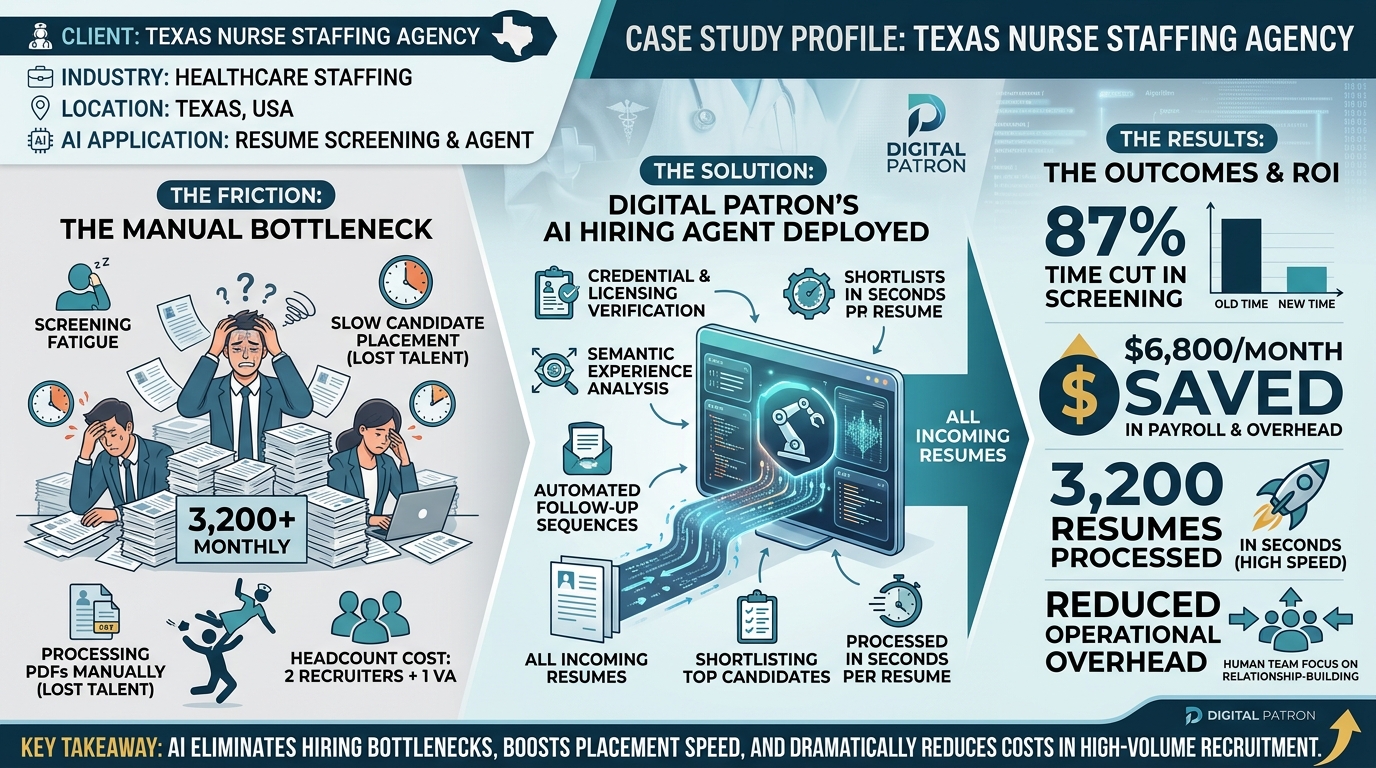
An AI agent replaced the manual recruiter workflow — screening 3,200 resumes in seconds, cutting 87% of screening time, and saving $6,800/month in payroll.
Verified Outcomes
The Brief
Engagement summary at a glance.
- Client
- Texas-headquartered nurse staffing agency (anonymised)
- Engagement
- 5-week build, ongoing monthly retainer
- Industry
- Healthcare Staffing
- AI hiring agent tuned for US RN credentialing
- Resume ingestion + parsing pipeline (PDF + DOCX)
- License verification against Texas BON + national NPDB
- Semantic shortlisting + cultural-fit scoring
- Automated multilingual candidate follow-up
- ATS sync + recruiter dashboard
The Context
What was happening before we stepped in.
A major Nurse Staffing Agency in Texas was drowning in 3,200 resumes. In medical staffing, speed is the only metric that matters — if you don't call a qualified RN within hours of posting, they have already accepted a different placement. The agency was paying two recruiters and a VA just to process PDFs.
The Problem
The friction we identified and eliminated.
This manual grind led to 'Screening Fatigue' — where human exhaustion caused recruiters to miss high-quality candidates while buried in paperwork. The cost of this bottleneck wasn't just payroll; it was missed placements, slower client delivery, and an inability to scale without linearly adding headcount.
Our Solution
The strategic and technical intervention.
We deployed a specialized AI Hiring Agent tuned for the US healthcare job market. The agent automatically ingests every resume, cross-references credentials and Texas state licensing requirements, semantically analyzes deep experience and cultural fit, shortlists top candidates, and triggers automated follow-up sequences — all in under 6 seconds per resume.
Implementation Summary
Deployed an AI hiring agent to automatically screen, credential-verify, shortlist, and follow up on all incoming nurse resumes.
Our Approach
The phased methodology, in order.
- 01
Mapped the recruiter's actual workflow, not the job description
We sat with the recruiters for two days and clocked exactly where their time went: 71% on PDF-flipping, 14% on credentialing checks, 12% on follow-up texts, and only 3% on candidate conversations. That ratio became the design constraint — automate the 97% so the 3% gets all the human attention.
- 02
Built a credentialing-aware resume parser
Generic resume parsers fall apart on healthcare. Nurse resumes have RN, BSN, MSN, ADN, LPN, LVN, NP, CNA, CMA designations layered with state-specific licenses, certifications (BLS, ACLS, PALS), and unit-specific experience (ICU, ER, OR, L&D). We trained the parser on real US nurse resumes so it extracts every credential cleanly and maps it to the agency's role schema.
- 03
Wired in real-time license verification
The agent verifies every claimed license live against the Texas Board of Nursing public roster and cross-checks against NPDB-equivalent public sources. Expired or unverifiable licenses are flagged before a human ever sees the resume — eliminating the placement-killing 'we found out at the credentialing stage' problem.
- 04
Engineered semantic shortlisting with explainability
Beyond keyword matching, the agent semantically reads the resume against the job order and scores fit on three axes: credentials, unit experience, and shift/location compatibility. Every score has a one-paragraph 'why this candidate' explanation the recruiter can read in 5 seconds — not a black-box number.
- 05
Automated bilingual follow-up to claim candidates fast
In healthcare staffing, the first agency to call wins. The agent sends a personalised English (and Spanish, where relevant) follow-up SMS + email to every shortlisted candidate within minutes of the resume arriving. The recruiter inherits the warm conversation, not a cold list.
What We Built
The artefacts shipped during the engagement.
Credentialing-aware resume parser
Trained on real US nurse resumes — extracts RN/LPN/CNA designations, state licenses, unit experience, and shift availability with high accuracy.
Live license-verification module
Real-time check against Texas BON and equivalent public registries; flags expired, suspended, or unverifiable licenses before recruiter review.
Semantic shortlisting engine
Scores candidates against the job order on credentials, unit experience, and shift/location fit — every score paired with a plain-English explanation.
Bilingual candidate follow-up
Personalised SMS + email follow-up in English and Spanish, sent within minutes of shortlisting.
Recruiter dashboard + ATS sync
Single-pane view of incoming resumes, shortlist quality, and candidate engagement — synced bidirectionally with the agency's ATS.
Measurable Outcomes
3,200 resumes processed end-to-end through the engine in the first 90 days — every one parsed, credential-verified, semantically scored, and either shortlisted or auto-rejected with a documented reason.
Median time from resume arrival to fully scored shortlist decision: under six seconds. Compared to 4–7 minutes per resume for the human team, the engine compresses a multi-day backlog into a real-time queue.
Total recruiter time spent on screening dropped 87%. The recruiters got their best week ever in week three of the engine being live — their time finally went to interviewing and placing, not paperwork.
Two recruiters and one VA's screening workload absorbed by the engine, saving $6,800/month in payroll. The remaining recruiters were redeployed to relationship management and active placement work.
The Stack
Project Timeline
- Wk 01
Workflow audit
Sat with recruiters, clocked time-on-task, defined the automation surface.
- Wk 02
Parser training
Resume parser trained on agency's historical resumes; credential taxonomy locked.
- Wk 03
Verification + scoring
License verification live; semantic shortlisting engine running on test cohort.
- Wk 04
Follow-up + ATS sync
Bilingual SMS + email engine live; ATS bidirectional sync verified.
- Wk 05
Production launch
Engine processing all incoming resumes; recruiters retrained on the new workflow.
- Wk 06+
Monthly retainer
Ongoing tuning against placement outcomes; monthly accuracy review.
“We were drowning. Three thousand resumes, two recruiters, and a VA all chasing the same candidates. Within a month of going live, my team got their evenings back and our placement velocity actually went up.”
Key Takeaway
“In high-volume recruitment, human screening is a bottleneck, not a benefit. AI provides the speed required to win in talent wars while dramatically reducing operational overhead — allowing your human team to focus on relationship-building, not PDF processing.”
Frequently asked, about this engagement.
How does the AI agent verify nursing licenses in real time?
We integrate directly with state nursing-board public rosters (Texas BON in this case, and equivalent boards for any state the agency operates in) plus national-level public registries. Every claimed license is checked live, and the engine flags expired, suspended, or non-matching licenses before a recruiter sees the resume.
Can this engine work for non-nursing healthcare staffing — allied health, therapists, locum tenens?
Yes. The architecture is staff-type agnostic — we re-train the parser on the credential vocabulary and re-wire the verification module against the right registries. We've adapted the same engine for therapy, locum, and allied health agencies with similar timeline and cost structure.
What about EEOC and bias risk in AI screening?
We score on credentials, experience, and shift/location compatibility — never on protected characteristics. We log every scoring decision with a plain-English explanation and a feature audit, and we run quarterly disparate-impact reviews. The recruiter sees the explanation alongside the score and can override any decision.
How long does an AI hiring engine take to ship?
5–7 weeks for a healthcare-staffing build. The first 2 weeks are training the parser on the agency's historical data and locking the credential taxonomy. The next 3 weeks are verification, scoring, and ATS integration. The final week is workflow training for the recruiters.
Related solutions
AI Hiring Agent for Staffing Agencies
Staffing agencies don't lose deals on candidate quality — they lose deals on screening speed. The first agency to call a qualified candidate wins the placement. We deploy AI hiring agents that screen 3,000+ resumes in seconds, verify state licenses live, and let your recruiters spend their time on the 3% of work that actually moves placements.
HR Tech Localisation for India Market Entry
International HR tech entering India usually fails for the same reason: they translate the US deck into Hinglish and call it localisation. We rebuild the entire go-to-market for Indian compliance reality and partner the engine with India's top payroll vendors — the playbook that took Extensis HR from near-zero to $20K MRR in 6 months.
Want results like Texas Nurse Staffing Agency?
Book a free 30-minute call. We'll map exactly what to build, what to skip, and what it should cost for your business.