
Hotel + restaurant + travel platforms engineered for direct bookings, real-time inventory, and zero-friction guest experience.
Most hospitality websites are pretty brochures bolted onto a generic CMS. We build hospitality platforms — hotel direct-booking engines, restaurant ordering, travel marketplaces, and multi-property real-time collaboration tools — engineered for the operational reality of hotel groups, F&B chains, and travel operators.
Why hospitality brands lose 60% of direct-booking margin — and how a real platform fixes it
OTAs (Booking, Agoda, MakeMyTrip) take 15–25% commission on every booking. F&B aggregators (Zomato, Swiggy) take similar cuts. The difference between a hotel or restaurant brand at 30% direct-booking share and one at 5% is purely the quality of their digital platform — speed, trust signals, real-time inventory, mobile-first UX, and a checkout that doesn't lose buyers. We build hospitality platforms that genuinely compete with the OTAs and aggregators on conversion, not just brand. We've shipped multi-property real-time collaboration tools (The Hotel Media), hotel direct-booking engines, restaurant ordering platforms, and travel marketplaces — every build is engineered to lift direct-booking share.
Capabilities of this web development stack.
Direct-booking engines for hotels
Inventory-aware booking engines with real-time room availability, dynamic pricing, OTA-parity rate management, and conversion-engineered checkout flows.
Restaurant ordering + reservation platforms
Direct-order platforms that compete with aggregators on conversion: real-time menu, table reservation, kitchen integration, and loyalty hooks.
Travel marketplaces + tour booking
Multi-supplier travel marketplaces with package builders, dynamic pricing, payment-gateway integration, and itinerary management.
Multi-property collaboration platforms
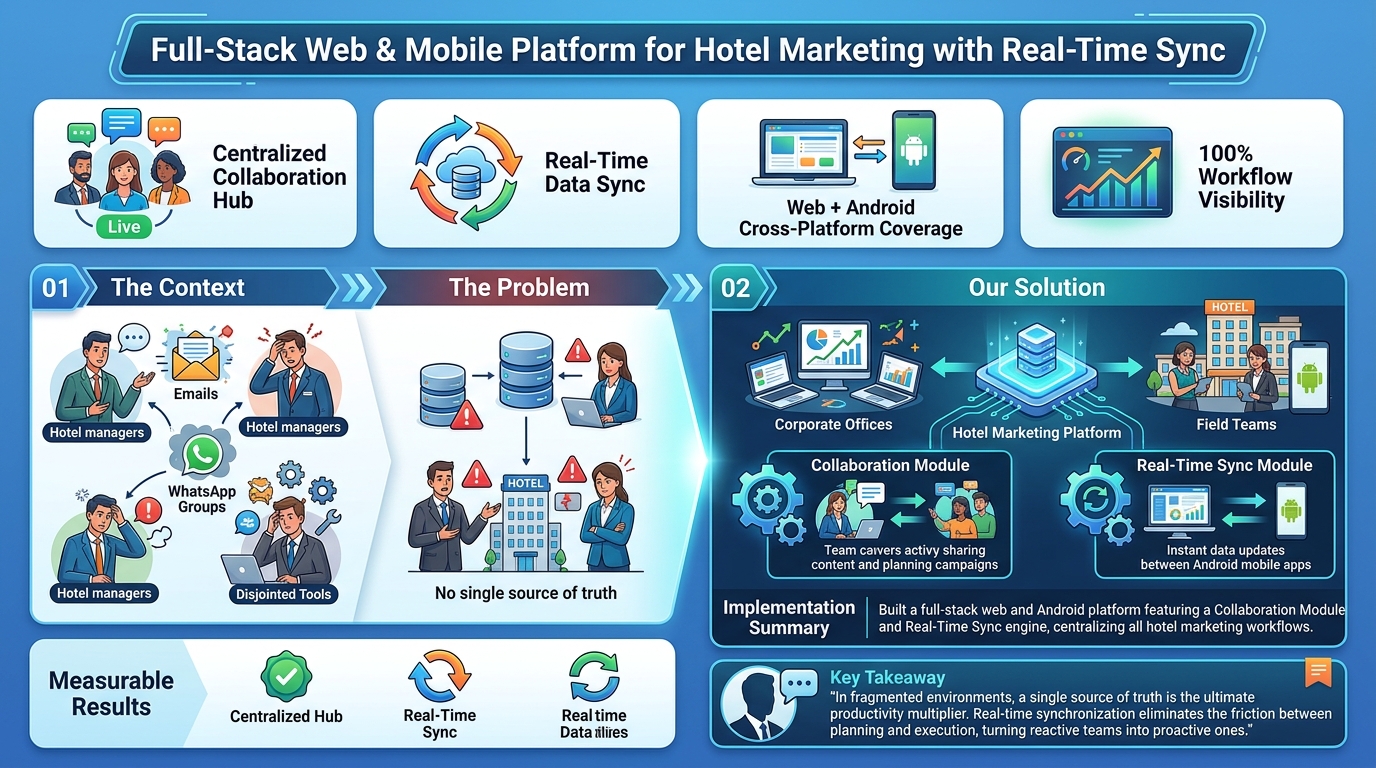
Real-time collaboration tools across web + native mobile for hotel groups managing campaigns, assets, and approvals across multiple properties (see: The Hotel Media).
Channel-manager + PMS integration
Two-way sync with major PMS (Cloudbeds, Mews, Opera), channel managers (SiteMinder, RateGain), and OTAs so direct and indirect inventory stay in lockstep.
Mobile-first, conversion-engineered UX
Every flow designed mobile-first with a 3-step checkout target. Page-speed optimisation that beats OTA-parity benchmarks. Trust signals engineered for hospitality-buyer psychology.
A predictable path from kickoff to live.
- 01
Audit your current direct-booking share
We pull 12 months of booking data: direct vs. OTA share, channel-level conversion rates, drop-off in the existing checkout, mobile vs. desktop performance. This is the baseline.
- 02
Map the operational reality (PMS, channels, properties)
We document every system that touches inventory: PMS, channel manager, OTAs, GDS, internal sales tools, multi-property campaign tools. The platform we build has to fit cleanly into that operational fabric — not bolt awkwardly onto it.
- 03
Design for mobile-first conversion
Every booking flow is designed mobile-first with a 3-step checkout. Trust signals (real photos, real reviews, real availability) engineered around hospitality-buyer psychology.
- 04
Build the platform with PMS + channel-manager integration
Two-way real-time sync with the existing PMS and channel manager, so a direct booking is reflected everywhere within seconds — and an OTA booking blocks the room from your direct site immediately.
- 05
Launch + run an OTA-parity push for direct-booking share
Coordinated launch: site live, paid search/Meta running on direct-booking offers (loyalty rewards, free upgrades, room flexibility), and weekly tracking against direct-share lift.
Outcomes we target on this work
The stack we use.
What this typically costs in India.
Boutique
₹8L–₹15L build + ₹40K/mo retainer
Single hotel / restaurant / 4–10 property boutique group. Direct-booking engine + PMS sync.
Group
₹20L–₹50L build + ₹1L+/mo retainer
Multi-property hotel or F&B group. Full platform with collaboration, multi-property campaigns, channel-manager sync.
Enterprise
₹60L+ build + custom retainer
Hotel chain, travel marketplace, or F&B aggregator. Bespoke architecture, multi-region, multi-currency, deep integration suite.
We've actually shipped this.
Questions, answered.
How much can a serious direct-booking platform actually lift our direct share?
Most hospitality brands we work with go from 5–15% direct-booking share to 25–40% within 9–12 months of launch. The lift comes from a combination of better mobile conversion, parity-friendly pricing/inventory, and a coordinated direct-booking-incentive push (loyalty, upgrades) that's genuinely visible against the OTA experience.
Will this work alongside our existing OTA distribution?
Absolutely — and it should. The goal isn't to leave OTAs (they're a critical demand channel for new guests). The goal is to win every repeat booking and direct-search booking onto your own platform, where you keep 100% of the margin and the guest data.
We have a complex multi-property + multi-brand setup. Can you handle that?
Yes. The Hotel Media build is exactly this — multi-property, multi-brand, with real-time collaboration across web and native Android. We've architected for hotel groups with 4–60 properties; the same architecture scales cleanly.
What about restaurant ordering — can you compete with Zomato/Swiggy?
On conversion, yes — direct-ordering checkout flows with proper UX and loyalty hooks regularly out-convert aggregator pages. On demand generation, you'll still need aggregators for new-customer reach, but every loyal customer should be ordering direct.
How long does a hospitality platform build take?
12–20 weeks for a boutique direct-booking engine. 20–32 weeks for a multi-property group platform. 32+ weeks for a full chain or marketplace build with deep PMS + channel-manager integration. The Hotel Media build was 16 weeks end-to-end with web + native Android + real-time sync.
Ready to ship a web development for hospitality?
Book a free 30-minute call. We'll come back with a fixed-scope proposal within 24 hours.