
RevOps for Indian SaaS: Building a Revenue Operations Function (2026)
What RevOps actually is (and why your ₹50L SaaS doesn't have it yet)
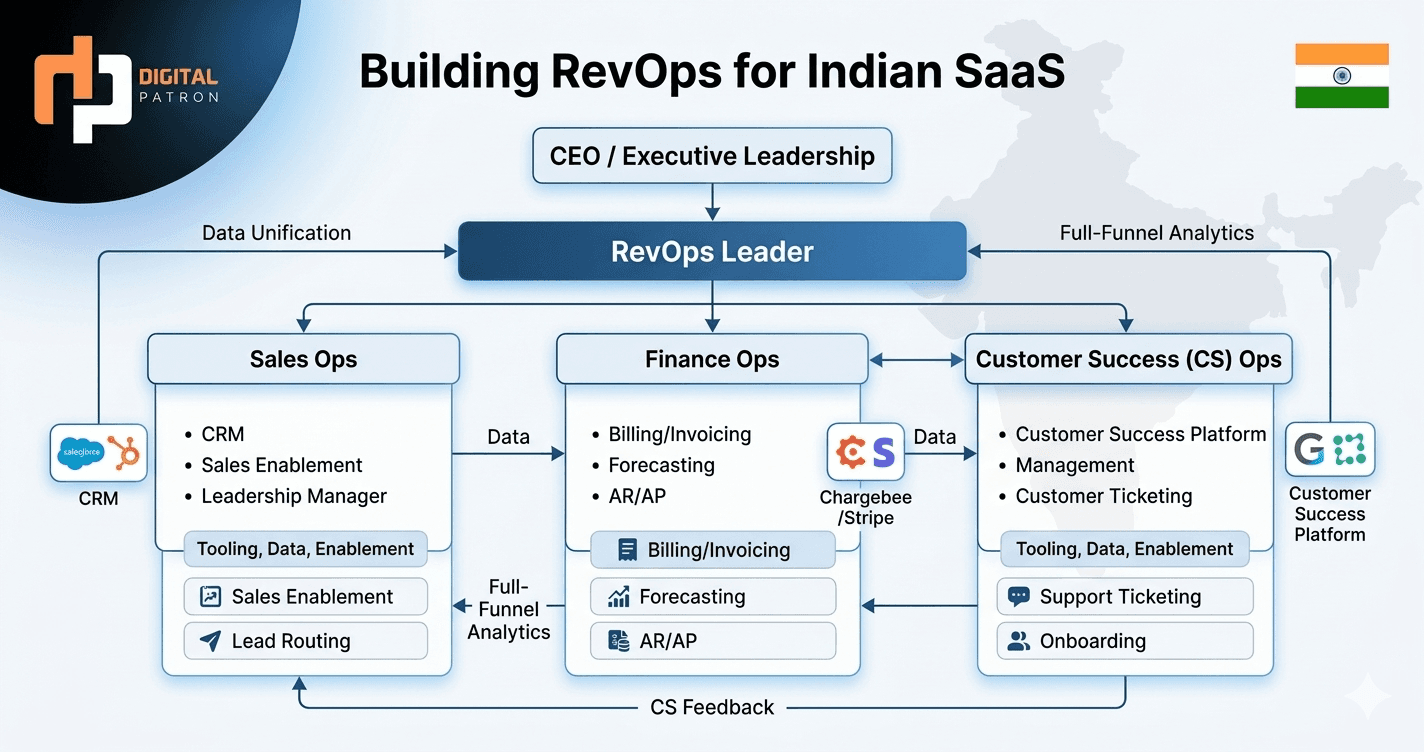
RevOps is short for Revenue Operations. It is the team (usually 1–3 people at a ₹1–5Cr SaaS company) that owns:
- Data integrity: CRM is the source of truth for the business. Are sales reps actually logging calls? Are pipeline stages correct? Are deal sizes accurate?
- Process alignment: Marketing hands off leads → Sales qualifies them → Customer Success onboards them. What happens in between each handoff? Where do leads get lost?
- Metrics and forecasting: Monthly recurring revenue (MRR), pipeline health, sales cycle length, close rates by rep/region/product. Which metrics actually predict growth?
- Tool stack optimization: What CRM works? What email platform? What analytics tool? Do they talk to each other? Most early-stage SaaS has a disaster here (5 different databases, manual spreadsheets, no integration).
RevOps is not SDR management (that's the VP Sales). It's not marketing (that's the CMO). It's the referee between them, ensuring the revenue machine actually works.
Why Indian SaaS companies don't have RevOps (and why they should)
Most Indian SaaS companies under ₹1Cr ARR don't have dedicated RevOps. Instead:
- CEO is manually checking pipeline in Salesforce
- Marketing and sales have conflicting definitions of "qualified lead"
- Sales reps aren't logging deals in CRM (most use Whatsapp to tell the CEO verbally, then CRM lags by 1–2 weeks)
- Forecasting is just the CEO asking sales head "how many deals will close this month?"
- Nobody knows the actual unit economics (cost per lead, cost per meeting, cost per customer)
Then the company hits ₹50L ARR, hires 3–4 sales reps, and suddenly the CEO can't track the pipeline manually. They lose ₹20–30L in potential revenue because deals slip through cracks (no one managing handoffs) or sales reps are chasing low-probability deals instead of high-probability ones (no visibility into pipeline health).
The RevOps build (phases 1–3)
Phase 1 (₹25–50L ARR): Hire 1 Operations person
Hire a "Sales Operations" person (₹8–12L/year). Their job for 6 months:
- Month 1: Audit CRM. Is Salesforce configured correctly? Are all reps logging data? Create a "data audit" scorecard: what % of deals have associated tasks? What % of leads are being marked SQL? Document all issues.
- Month 2–3: Clean the pipeline. Delete ghost deals (deals with no progress in 60+ days). Update old deal dates. Standardize stage definitions ("Negotiation" used to mean 3 different things; now it means X).
- Month 4–6: Build dashboards. Monthly pipeline overview, forecast accuracy, lead source attribution, cost per lead. Report to leadership weekly.
Outcome: You now have visibility. You can answer: "How many deals will close this month?" within 80–90% accuracy (vs. the CEO guessing).
Phase 2 (₹50L–2Cr ARR): Establish processes and metrics
The Ops person now owns:
- Lead qualification process: Define SQL criteria. E.g., "SQL = company in ICP + decision maker reached + budget confirmed." Every lead is scored against this. Marketing knows exactly what to target. For complex opportunities, use a MEDDIC qualification framework after the SQL handoff.
- Sales handoff process: When does marketing hand off to sales? After first reply? After scheduled demo? Define it and measure adherence.
- Weekly metrics review: Monday morning sync: how many SQLs generated? Pipeline health? Which reps are at risk of missing quota? What do they need to close the gap?
- Monthly business review: CEO + sales + marketing + ops sit down. Review: pipeline, close rate, deal size, cost per customer, cash flow projection. Identify bottlenecks and fix them.
Outcome: Revenue becomes predictable. You can say: "We'll generate ₹3Cr pipeline this quarter" and you're within 10–15% of actual.
Phase 3 (₹2Cr–5Cr ARR): Build a team and tool stack
Hire a 2nd ops person (analytics/finance focus). Standardize tools:
- CRM: HubSpot or Salesforce (not Pipedrive, not Zoho — at this scale you need integrations)
- Marketing automation: Mailchimp, HubSpot, or Intercom (to track email engagement and hand off warm leads to sales)
- Analytics: Looker, Tableau, or Metabase (to visualize pipeline, ARR, churn, CAC, LTV)
- Integrations: Zapier or custom API layer so CRM, email platform, and calendar sync automatically
Outcome: You have a true revenue engine. Sales can forecast accurately. Marketing can optimize. Finance can project cash flow.
The tooling (minimal for Phase 1, robust for Phase 3)
Phase 1 tooling (₹4–8L/year):
- Salesforce (₹150K/mo or HubSpot ₹80K/mo)
- Google Sheets + Data Studio for dashboards (free)
- Gmail + Intercom for lead routing (₹20K/mo)
Phase 3 tooling (₹15–25L/year):
- Salesforce or HubSpot (₹150–300K/mo)
- Looker or Tableau (₹50–100K/mo)
- Zapier or Segment (₹20K/mo)
- Intercom or HubSpot for lead routing (₹30–50K/mo)
- Custom data warehouse (Snowflake or BigQuery) if you have data engineering resources
The quick-start (do this week)
- Day 1: Audit your Salesforce/CRM. How many deals are older than 90 days with no activity? (Goal: <5% of pipeline.) How many deals have all required fields filled? (Goal: >90%.)
- Day 2–3: Define "SQL" for your company. Write it down. Send to sales and marketing. Make sure they agree.
- Day 4–5: Build a simple dashboard: "How many SQLs did we generate this month? What's our pipeline? What's our forecast?" Share it with leadership every Friday.
- Day 7: Start a weekly "revenue sync": 30 min on Monday morning with sales + marketing + CEO. Review: SQLs, pipeline, forecast, any blockers.
Want help building RevOps for your SaaS? Book a 45-min operations audit. We'll review your current process (or lack thereof), build a 90-day RevOps roadmap, and tell you exactly what you need to hire for.