
How to Price Cold Email Services: 2026 Agency Pricing Model
The three pricing models and their unit economics
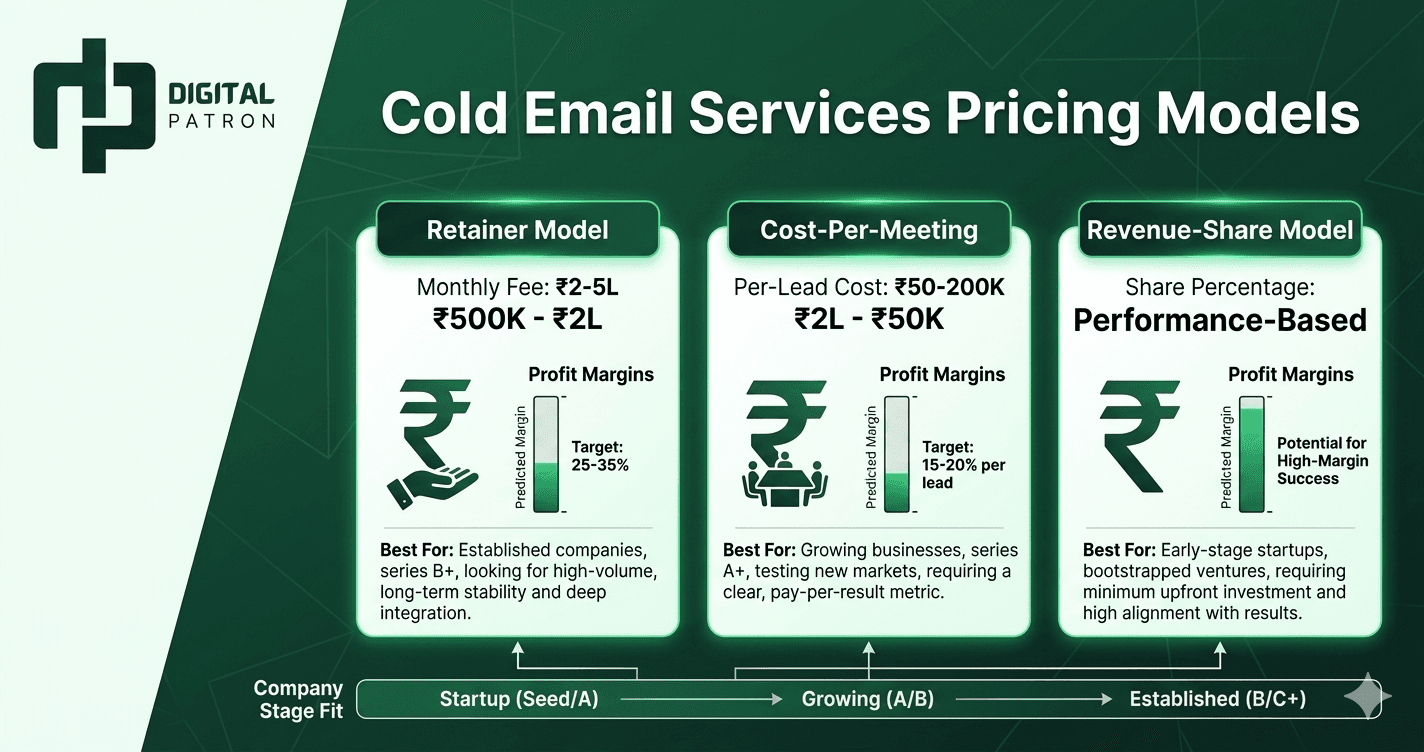
Model 1: Retainer (Monthly flat fee)
Structure: Client pays ₹2–5 lakh/month for your team to run their cold email. You cover all costs (tools, people, list, domain management).
Typical service delivery:
- List research and enrichment: 40 hours/month
- Campaign setup and sequencing: 20 hours/month
- Daily monitoring and optimization: 30 hours/month (10 hours/week)
- Reporting and strategy sessions: 10 hours/month
- Total: ~100 hours/month of FTE effort
Cost breakdown (per client):
- SDR/specialist labor: ₹1.5–2L/month (covers 100 hours at ₹15–20K/hour loaded cost)
- Tools (email platform, enrichment, CRM integration): ₹20–30K/month
- List costs / data: ₹10–15K/month
- Overhead (office, management, benefits): ₹30–40K/month
- Total cost: ₹1.7–2.25L/month
If you charge ₹3L/month retainer:
- Margin: ₹3L - ₹2L = ₹1L/month margin (33% gross margin)
- This assumes 100% utilization (the specialist is not selling, not in gaps, always working 100 hours on this client)
Pros: Predictable revenue, recurring, easier to scale (hire 1 SDR = can take 1 retainer client).
Cons: Highly commoditized; clients always shop you against "cheaper" agencies in India; difficult to expand if client doesn't see ROI; client churns = team slack.
Model 2: Cost-per-meeting (CPM)
Structure: Client pays ₹50K–200K for every booked meeting you deliver. You cover all costs upfront; revenue only comes when you deliver results.
Typical structure:
- Tier 1: ₹50K per qualified meeting (broad ICP, lower bar for "qualified")
- Tier 2: ₹100K per SQL-level meeting (well-qualified, high likelihood to advance to opportunity)
- Tier 3: ₹150–200K per high-intent meeting (CMO-level, clear buying signal, usually books fast)
Unit economics (assuming ₹100K per meeting):
- Cost to deliver 1 meeting: ~₹25–35K (10–14 hours of SDR labor + tools + list)
- Margin per meeting: ₹100K - ₹30K = ₹70K (70% margin, assuming low overhead allocation)
- Meetings per SDR per month: 4–8 (depends on follow-up rate and your funnel efficiency)
- Revenue per SDR per month: 6 meetings × ₹100K = ₹60L gross, ₹42L net margin
Pros: Revenue directly tied to performance; higher margins; easier to sell to price-sensitive clients ("only pay if we deliver").
Cons: Unpredictable monthly revenue (if client's ICP shifts, you might only book 3 meetings instead of 6); high customer acquisition friction (clients want to negotiate the per-meeting price); difficult to forecast cash flow.
Model 3: Revenue-share / Commission
Structure: Client pays you 10–20% of the revenue generated from customers you bring in (for 12+ months after the first meeting).
Example:
- You book 8 meetings/month for a client
- Client closes 2 deals/month at ₹10L ACV average
- 2 deals × ₹10L = ₹20L new ARR per month
- You get 15% commission = ₹3L/month, forever (or for 12 months)
Unit economics:
- Assuming 20–25% close rate, a booked meeting is worth ₹25L in revenue (8 bookings → 2 deals → ₹20L).
- At 15% commission, 1 booking is worth ₹3.75L in total value (₹15L/meeting, paid over 12 months).
- Cost to book 1 meeting: ₹30K
- Margin: ₹3.75L/12 = ₹31K/month ongoing from 1 meeting, minus the cost to deliver it = ₹1K/month (5% monthly margin, but compounding across all bookings from all clients).
- Revenue per SDR per month: 6 meetings × ₹3.75L = ₹22.5L annual recurring (₹1.875L/month).
Pros: Highly motivating (you're a true partner in client's success); high lifetime value; easier to scale (more clients, more meetings, more compounding commission).
Cons: Very long payback period (you book in month 1, but don't get paid until month 2+, and the payment compounds over 12 months); requires trust (client might dispute your "credit" for a deal); hardest to manage cash flow.
How to choose the right model for your stage
Pre-product market fit / <₹25L ARR: Use cost-per-meeting or retainer. You need predictable revenue. Revenue-share is too risky at this stage.
₹25L–₹1Cr ARR (growth stage): Mix of retainer (60%) + cost-per-meeting (40%). Retainer provides cash flow stability; CPM helps you attract bigger clients who want performance-based pricing.
₹1Cr+ ARR (scale stage): Introduce revenue-share for top-tier clients. Add a "managed service" premium (₹5–8L/month retainer) for clients who want hands-on partnership, and keep CPM for transactional clients.
The pricing trap: why "cheap" kills agencies
Agencies often underpriced and then can't scale. They charge ₹1.5L/month retainer (below their cost) to "win the client," then discover they're running a loss. When they try to raise prices to ₹3L, the client leaves.
Rule: never charge below your cost + 20% minimum margin. If you can't charge ₹3L/month for cold email, the problem isn't your pricing — it's that your value prop is weak. Fix the value prop first (better results, faster timeline, or different target buyer), then raise prices.
On the buyer side of this? See how a managed appointment setting service is priced and qualified, or weigh it against running the tool yourself in Apollo vs a done-for-you team.
Want pricing consultation? We help agencies value their services and structure models that scale. Book a 30-min call with our team.