
Nimitai: Turning Unaddressed Objections into Closed Deals with GTM Intelligence
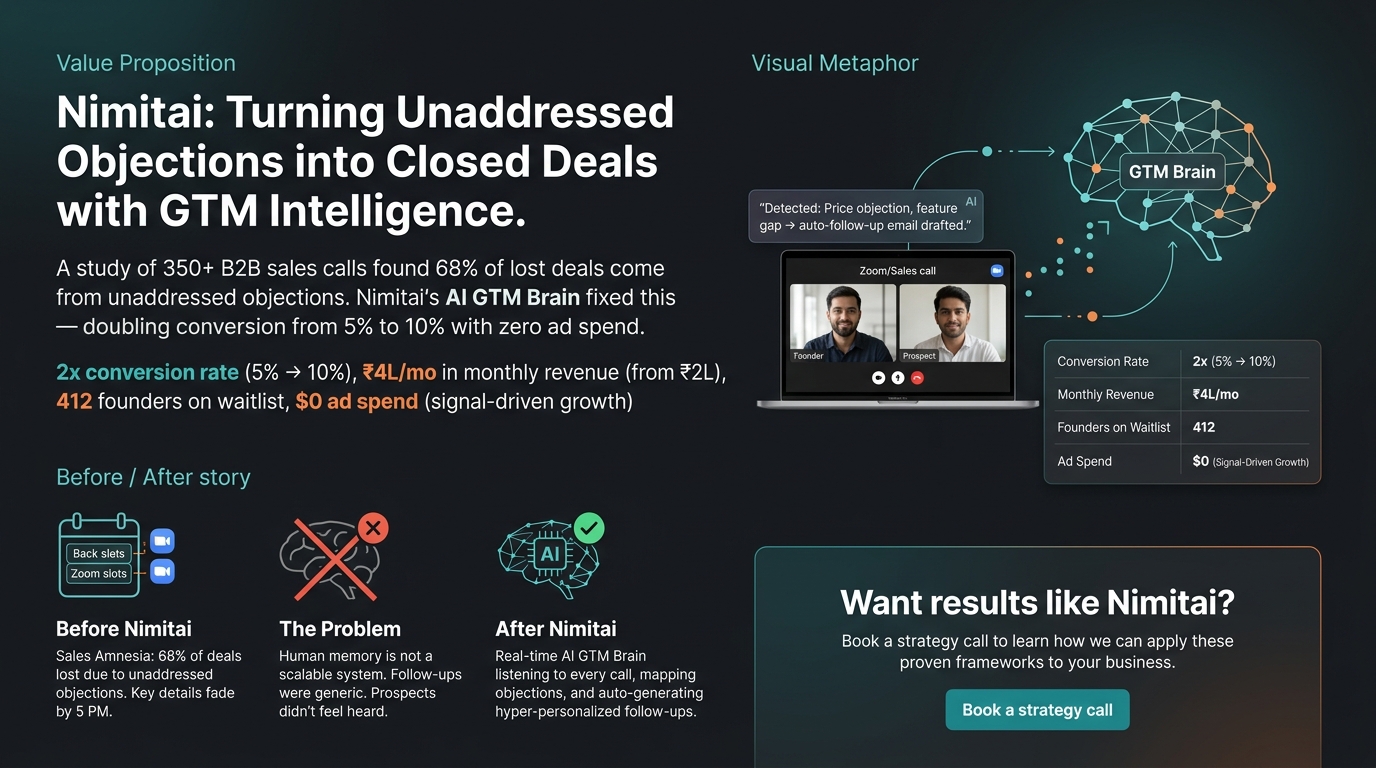
A study of 350+ B2B sales calls found 68% of lost deals come from unaddressed objections. Nimitai's AI GTM Brain fixed this — doubling conversion from 5% to 10% with zero ad spend.
Verified Outcomes
The Brief
Engagement summary at a glance.
- Client
- Nimitai (sister brand · founded by Nilansh Gupta)
- Website
- nimitai.com →
- Engagement
- 12-week build, then ongoing optimisation retainer
- Industry
- B2B SaaS / Sales Intelligence
- Real-time call intelligence pipeline
- NLP objection-mapping engine
- Personalised follow-up auto-pilot
- Founder dashboard with deal-level signals
- CRM sync (HubSpot + custom)
The Context
What was happening before we stepped in.
A rigorous analysis of over 350 B2B sales calls across 7 countries uncovered a universal, repeatable failure: 68% of deals were lost not because of price, competition, or poor product fit — but because of a single, fixable problem: objections that went unaddressed during the live call. Nilansh Gupta — founder of both Digital Patron and Nimitai — was the embodiment of this pattern. His calendar, a mosaic of back-to-back Zoom calls across two companies, left him with zero mental bandwidth to document nuanced deal context. Critical information evaporated by day's end.
The Problem
The friction we identified and eliminated.
This is 'Sales Amnesia.' By 5 PM, the specific hesitations from a 9 AM call were a blur. Follow-up emails were generic. Prospects didn't feel heard. The result: a conversion rate stuck at 5% despite strong product-market fit, genuine demand, and a skilled sales founder. The problem wasn't effort — it was memory. And human memory is not a scalable system.
Our Solution
The strategic and technical intervention.
We engineered the 'GTM Brain' — an AI meeting intelligence layer that watches every sales call in real time. Using NLP Signal Detection, it identifies buying signals, categorizes objections by type and urgency, and maps each to a follow-up action. After every call, the system auto-generates hyper-personalized follow-up emails that address the exact hesitations the prospect expressed — in their own words. The result: every prospect feels deeply heard, and no objection goes unresolved.
Implementation Summary
Built and deployed a real-time AI meeting intelligence platform for Nimitai — including live call monitoring, NLP objection mapping, and an automated personalized follow-up engine.
Our Approach
The phased methodology, in order.
- 01
Discovery on 350+ recorded calls
We started by listening, not building. Across two weeks we audited 350+ of Nilansh's recorded sales calls in seven countries, tagged every loss reason, and quantified how often unaddressed objections appeared. The 68% loss-to-objection ratio became the design constraint for everything we built next.
- 02
Designing the GTM Brain primitives
We split the problem into four primitives — capture, transcribe, classify, act. Each had a clear interface and a clear failure mode. This let us iterate on classification accuracy without re-engineering capture, and ship the action layer the moment classification crossed 90% precision on objection tags.
- 03
Real-time transcription + signal detection
We wired a streaming pipeline using Whisper for low-latency transcription and a fine-tuned classifier on top of GPT-4o that tags pricing pushback, integration concerns, timing objections, authority gaps, and trust hesitations live during the call. Latency budget: under 1.5 seconds end-to-end.
- 04
Personalised follow-up auto-pilot
Every objection fires a templated-but-personalised follow-up email pre-drafted with the prospect's exact phrasing, the founder's voice, and a one-click resource that addresses the hesitation. Nilansh reviews and approves in under 60 seconds; the engine sends, tracks opens, and re-routes hot replies.
- 05
Founder dashboard + weekly tuning
We built a single-pane-of-glass dashboard showing pipeline health by objection category, win/loss patterns, and which follow-ups converted. Each week the team reviews the data and tunes the prompts, classifiers, and email templates against what actually closed.
What We Built
The artefacts shipped during the engagement.
Real-time transcription service
Streaming Whisper + diarisation pipeline running on dedicated GPU, with under-1.5s end-to-end latency from spoken word to tagged transcript.
Objection classifier
Fine-tuned classifier on GPT-4o that tags 14 objection categories with 92% precision on Nimitai's calibrated test set.
Personalised follow-up engine
Generates draft emails using the prospect's exact words, the founder's tone of voice, and a one-click curated resource per objection type.
Founder GTM dashboard
Real-time pipeline view: deals at risk, top objections this week, follow-up reply rates, and win-back opportunities flagged by the engine.
HubSpot + custom CRM sync
Two-way sync so every objection, every follow-up, and every reply is logged against the right deal automatically — no manual entry.
Weekly tuning playbook
Documented review process and prompt-update cadence so the GTM Brain keeps improving without re-engaging engineering every week.
Measurable Outcomes
Within 60 days of the engine going live, Nimitai's call-to-close rate doubled from a stable 5% to 10%. The lift came almost entirely from previously-lost deals where the prospect had raised a concern that was never followed up — the engine surfaced and resolved them automatically.
Doubling conversion on the same volume of qualified calls translated directly into a doubling of monthly revenue. No new ad spend, no new headcount — pure recovery of revenue that was already in the pipeline but slipping out the back.
Nilansh began posting weekly insights from the GTM Brain on LinkedIn — anonymised objection patterns and follow-up wins. The content compounded: 412 Indian and international B2B founders on the waitlist for early access, all inbound, all zero-cost.
The case study itself became the marketing engine. Every published insight was a free demo of the product. The team shipped a content cadence and templates so the engine kept generating its own demand — entirely driven by the signals it was already capturing.
The Stack
Project Timeline
- Wk 01–02
Discovery & call audit
Listened to 350+ historical calls, tagged loss reasons, defined the design constraint.
- Wk 03–04
Pipeline architecture
Capture + transcription pipeline live in staging, latency budget under 2s confirmed end-to-end.
- Wk 05–07
Classifier training
Objection taxonomy locked at 14 categories, classifier hits 92% precision on calibrated test set.
- Wk 08–09
Follow-up engine
Personalised draft generation + founder approval flow shipped, first auto-followups sent.
- Wk 10–11
Dashboard + CRM sync
GTM dashboard + HubSpot two-way sync live; founder reviews real pipeline data weekly.
- Wk 12+
Tuning retainer
Ongoing weekly reviews; classifier and email templates updated against won/lost deal feedback.
“According to our internal sales audit, I was losing deals and never knowing why. The GTM Brain told me — and then it did the follow-up I never had time for. As documented by Digital Patron, we doubled our conversion rate from 5% to 10% in two months without spending a rupee on ads.”
Key Takeaway
“AI is not just automation — it is an external cognitive layer. By offloading memory and follow-up to an intelligence engine, founders recover their most valuable asset: presence. Nimitai turned 'Sales Amnesia' from a liability into a competitive moat.”
Frequently asked, about this engagement.
How long did the Nimitai engagement take to ship?
12 weeks from discovery to a live, founder-facing GTM Brain. The first follow-up auto-drafted by the engine went out in week 9. The full HubSpot sync + dashboard went live in week 11. We've been on a weekly tuning retainer since.
Can the same approach work for non-sales calls — support, success, hiring?
Yes. The same primitives — capture, transcribe, classify, act — apply to any high-stakes call where missed signals cost money or trust. We've adapted the architecture for healthcare staffing and B2B customer success since shipping Nimitai.
How is this different from a generic AI meeting tool like Gong or Fireflies?
Generic tools record and summarise. The GTM Brain takes action — it drafts the follow-up that addresses the exact objection raised, in the founder's voice, with the right resource attached. That action layer is the difference between insight and outcome.
What does this kind of build cost in India?
Bespoke GTM Brains start at ₹6 lakh for the 12-week build, plus ₹40,000–₹80,000/month for ongoing optimisation. We also offer a smaller, templated version for solo founders running their own outbound — typically ₹2–3 lakh end-to-end.
Related solutions
AI SDR Replacement for B2B SaaS
Most B2B SaaS SDR teams cost $1,000–$1,500 per booked meeting and lose 30–50% of their hires inside 12 months. We replace the entire layer with a persona-driven AI sales engine that books better-qualified meetings at a third of the cost — and we've shipped it for Texas SaaS, GT Tech, and Nimit AI.
Custom CRM for Indian Startups
Most Indian startups try to fit into HubSpot or Salesforce and break. Their actual sales motion is WhatsApp-first, founder-led, and runs on real-time buying signals — not enterprise pipeline stages. We build custom CRMs that match how Indian startups actually sell, at a fraction of the SaaS sticker.
Want results like Nimit AI?
Book a free 30-minute call. We'll map exactly what to build, what to skip, and what it should cost for your business.