

The 2026 AI Sales Stack: Every Tool Your SaaS Team Actually Needs
The bloat problem: why more tools = less productivity
The average B2B SaaS sales team uses 8–12 different tools: Salesforce, HubSpot, Outreach, Gong, Apollo, ZoomInfo, LinkedIn Sales Navigator, Slack, Gmail, Calendly, and 3–4 others they forgot they were paying for. The wider state of B2B sales AI in 2026 shows how quickly this category is expanding. Total bill: ₹3–5L/month.
The problem: they don't talk to each other. A prospect replies to an email in Gmail, but the AE has to manually log it in Salesforce. Gong records a call, but doesn't automatically pull insights into Salesforce. Three different databases, zero single source of truth.
Result: sales reps spend 30–40% of their day doing admin (logging calls, updating pipeline, copying data between tools) instead of selling. Deals slip through cracks because nobody has visibility.
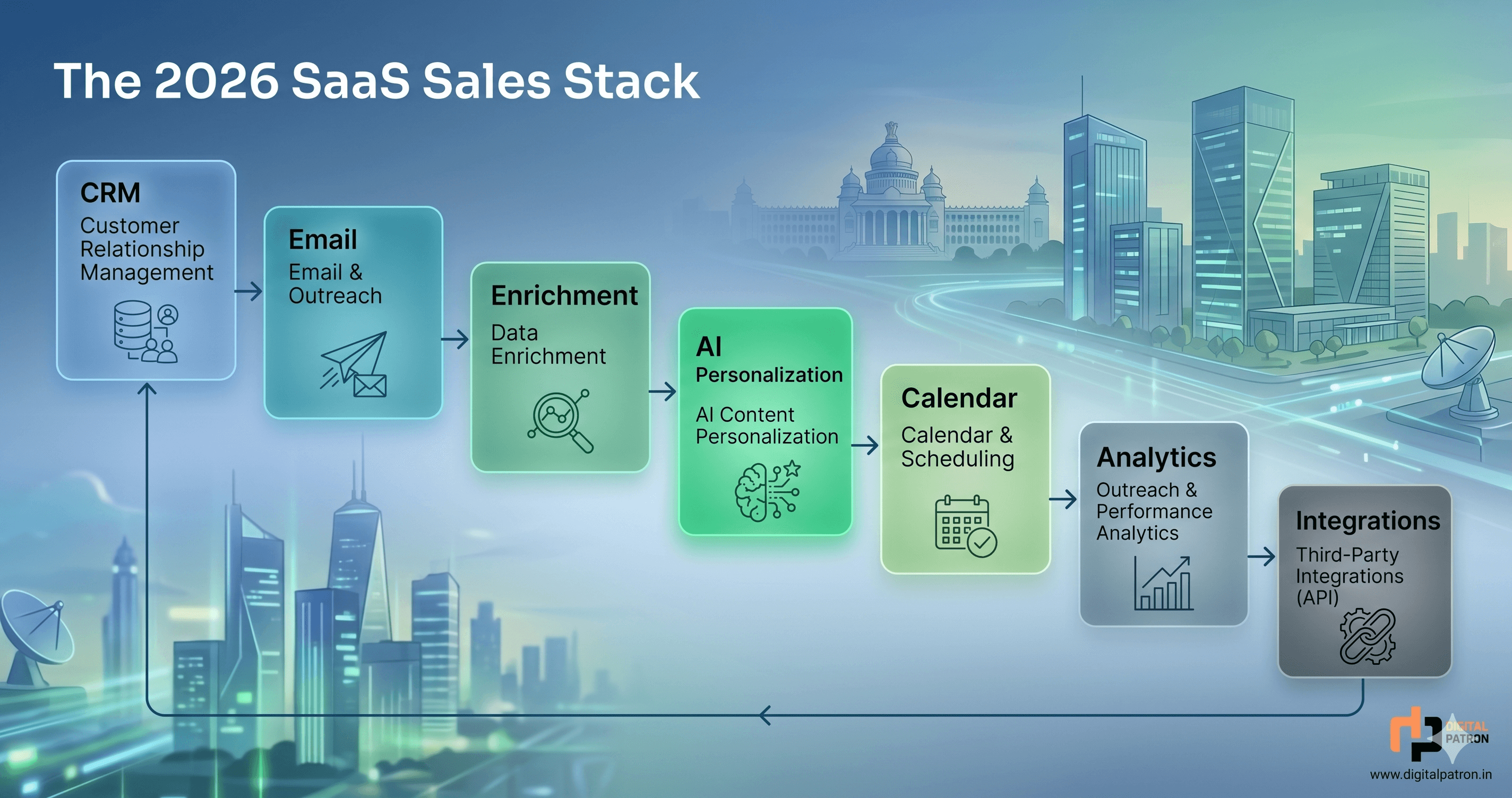
Here's the minimal stack that actually works in 2026:
Layer 1: CRM (source of truth)
Pick one: HubSpot or Salesforce
- HubSpot: ₹80K–150K/month depending on tier. Better for teams <20 people. Easier to set up, has built-in email, automation, and basic AI. Pick this if you want to move fast.
- Salesforce: ₹150K–300K/month. Better for enterprises or teams >50 people with complex workflows. Pick this if you need deep customization or have existing Salesforce infrastructure.
Non-negotiable features:
- Custom fields (to track your specific deal stages, qualification criteria, and metrics); teams using MEDDIC can benchmark these with a free MEDDIC scorecard
- Automation (e.g., "when AE marks this as 'negotiation,' auto-send contract template to legal")
- Reporting (pipeline by rep, by stage, by ACV; forecast accuracy over time)
- API (so other tools can push/pull data)
Cost: ₹80–150K/month. Critical? YES. Skip this and you have zero visibility.
Layer 2: Email + Calendar (engagement layer)
For inbound/warm email: Use HubSpot's built-in email (if you went HubSpot) or Gmail + Salesforce integration.
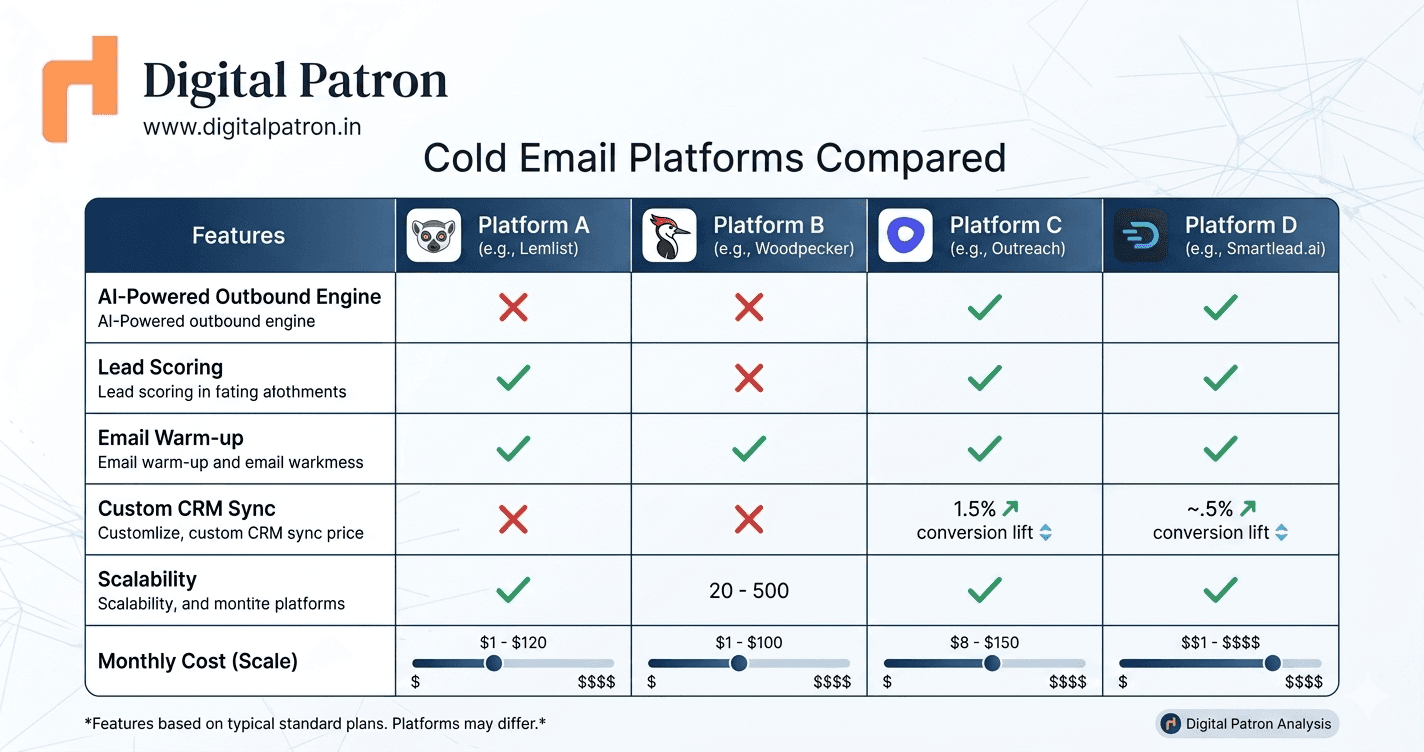
For outbound/cold email: Use Instantly, Smartlead, or Apollo (₹10–30K/month). Why separate from HubSpot? Cold email requires domain warm-up, authentication, and deliverability management that HubSpot isn't optimized for.
Calendar: Calendly or native integration
- Calendly (₹5–10K/month for teams): One-way booking (prospects see your availability and book)
- Salesforce/HubSpot calendar integration (built-in): Two-way sync with CRM, so booked meetings auto-log as activities
Cost: ₹15–40K/month combined. Critical? YES (50% of sales is setting up the meeting).
Layer 3: Data enrichment + intent (targeting layer)
Pick one: Apollo or ZoomInfo
- Apollo: ₹10–20K/month. Best-in-class B2B email database (50M+ companies, 200M+ contacts). Integrates with Salesforce. Pick this for efficient outbound.
- ZoomInfo: ₹50–100K/month. Richer firmographic data (funding, hiring changes, intent signals). Pick this if budget isn't tight and you want predictive insights.
Skip: LinkedIn Sales Navigator (₹6K per seat = ₹50K+ for a team, but unreliable data) and HubSpot's built-in database (clean but small).
Cost: ₹10–20K/month. Critical? MODERATE (helps with targeting, but not mission-critical if you have a warm lead source).
Layer 4: AI coaching (performance layer)
Pick one: Gong, Chorus, or Orum
- Gong: ₹100–200K/month depending on team size. Most mature AI coaching platform. Automatically records calls, transcribes, and surfaces coaching insights.
- Chorus: ₹80–150K/month. Lighter weight than Gong, easier to set up. Good for teams 10–30 reps.
- Orum: ₹30–60K/month. Cheaper but younger platform. Pick this if you're optimizing for cost.
What you get: Every call is automatically recorded, transcribed, and analyzed. Reps get coaching insights in real-time. You can measure "reps following the playbook" (did they ask about budget?) and see which behaviors correlate with closes.
Nimitai is one founder-led option in this layer: it prepares a 90-second pre-call dossier and provides live in-call guidance. Its Founding 500 seat is $99, while standard pricing is $149 per seat per month.
Cost: ₹30–200K/month depending on team size. Critical? MODERATE (nice to have but not mission-critical if your manager is good at coaching).
Layer 5: Integrations (the glue)
You don't need more tools; you need your tools to talk to each other. Use Zapier or native integrations to wire up:
- Email (HubSpot or Outreach) → CRM (activity logs)
- Calendar booking (Calendly) → CRM (meeting creation)
- Call recording (Gong) → CRM (activity + coaching attach to deal)
- Enrichment data (Apollo) → CRM (company details on lead)
- Slack (optional) → CRM (notifications when deals move stages)
Cost: ₹5–10K/month for Zapier. Critical? YES (without integration, tools are just separate data silos).
The budget breakdown
- CRM: ₹80–150K/month (HubSpot) or ₹150–300K (Salesforce)
- Email + outbound: ₹15–40K/month
- Enrichment: ₹10–20K/month
- Coaching (optional): ₹30–200K/month
- Integration: ₹5–10K/month
- Total: ₹140–620K/month depending on team size and needs
For a 5-person sales team, that's ₹2.8–12.4L/year. For a 20-person sales team with AI coaching, that's ₹3.3–15L/year. The ratio: ₹170K–750K per sales rep per year. Reasonable range.
What NOT to buy in 2026
- LinkedIn Sales Navigator (for cold outreach): Unreliable data, high seat cost. Use Apollo instead.
- Outreach.io (if you're SMB): Overengineered for teams <10. Use HubSpot email instead.
- ZoomInfo (unless budget >₹50L/year): Overkill unless you're doing large-scale intent-based outreach.
- Multiple CRMs: Do not use Salesforce + HubSpot + Pipedrive. Pick one and commit.
- Generic "AI sales assistant" startups: If they don't integrate with your CRM, they're just adding noise to your stack.
The migration plan (if you're currently bloated)
Month 1–2: Audit. List all tools. Track: who uses each? What data lives there? What integrates? Estimate total cost.
Month 2–3: Pick CRM. If you're on Pipedrive/Zoho, migrate to HubSpot. It's a 3–4 week project. Do it once, do it well.
Month 3–4: Integrate critical tools. Email + enrichment + calendar should feed into CRM automatically.
Month 4+: Kill the rest. Cancel LinkedIn Sales Nav, old tools, redundant vendors. Every ₹10K/month you save buys you better integrations or hiring.
Want a stack audit? Book a 30-min tools + integration review. We'll identify what you can kill, what you need, and the cleanest migration path.