
Conversion Rate Optimization for B2B SaaS: Cold Email → Sales Call
The invisible problem: high reply rate, zero meetings
We worked with a Bangalore SaaS company (Series A, ₹2Cr ARR) that was getting 3.2% reply rate on cold emails — which sounded great until we dug into the replies. Of 500 replies per month:
- 180 were "Tell me more" / "Interesting, send me info" (high engagement, but not a meeting request)
- 120 were competitor-comparison questions ("How is this different from [tool]?")
- 100 were objections ("We just bought [alternative]", "Too expensive", "Our team is full")
- Only 47 were explicit meeting requests ("Let's jump on a call")
Worse: only 32 of the 47 meeting requests actually showed up. So: 500 replies → 3.2% reply rate (good) → 32 booked calls (6.4% of replies actually converted) → typical close rate of 15% = 5 deals per 500 email outreach attempt.
At ₹30K ACV, that's ₹150K in committed revenue from 500 emails, or ₹300 cost per ARR. Sounds okay until you realise the founder was comparing it to a 12% meeting-booking rate from manual founder outreach. So the automation was working, but the optimization was non-existent.
This post is the CRO bridge: how to turn replies into meetings and meetings into deals, and how to measure it.
The funnel: 5 conversion steps and where you're leaving money on the table
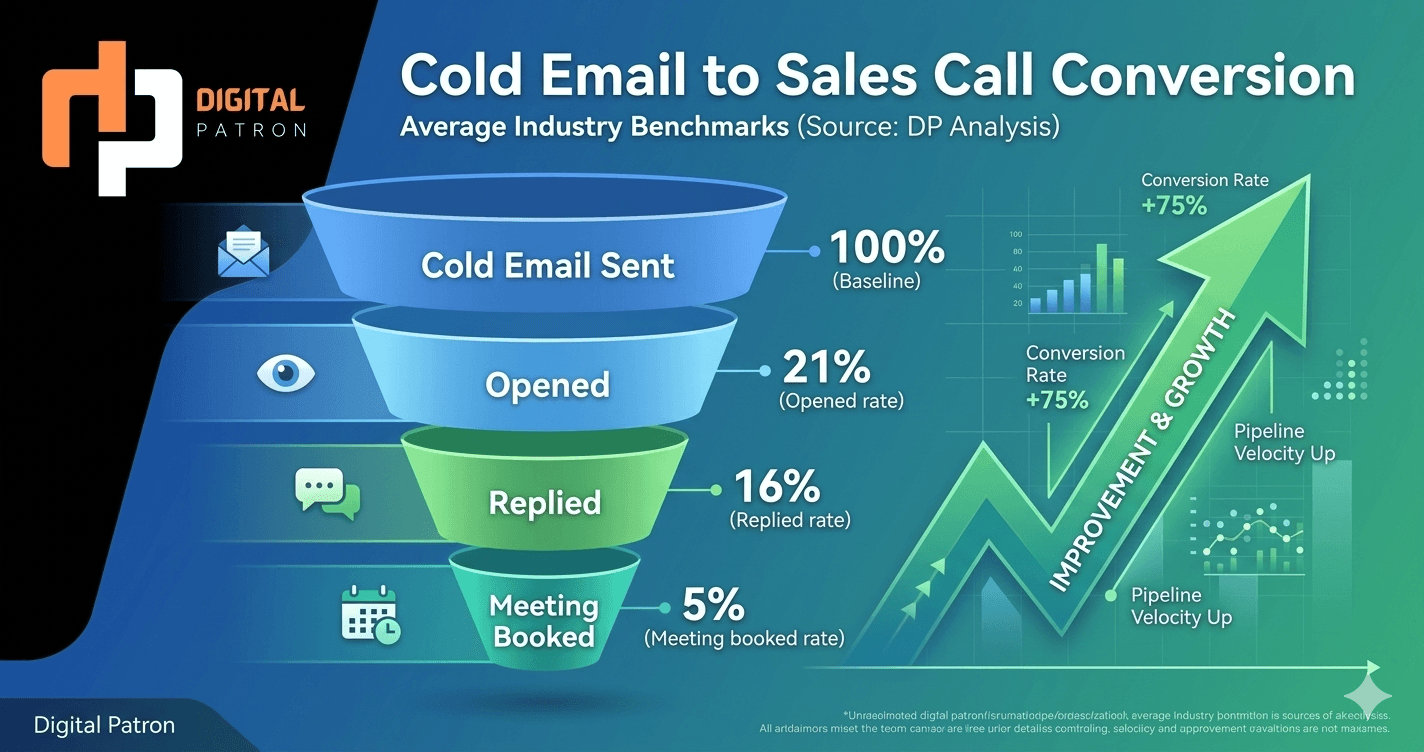
Step 1: Email sent → Email opened (45–55% open rate is typical for properly warmed domains)
Step 2: Email opened → Email replied (2.8–4.1% reply rate for proper outreach)
Step 3: Email replied → Demo request in first reply (12–18% of replies are explicit demo requests; the rest are information requests or objections)
Step 4: Demo request → Demo actually booked (60–75% of "let's talk" replies actually show up in your calendar)
Step 5: Demo attended → Opportunity created (15–28% of demos convert to active pipeline)
Your job is to optimise each step. Here's where most teams fall short:
- Teams focus on Step 1 (open rate) and Step 2 (reply rate) and ignore Steps 3–5.
- Steps 3–5 are where the actual revenue lever lives — a 2% improvement in "reply to demo" conversion = 40% more pipeline without touching copy or list quality.
Step 3: Reply → Demo request conversion (The critical handoff)
When a prospect replies "Tell me more about your pricing," they are not asking for a call. They are asking for information. You now have two choices: (A) send them a detailed email about pricing, or (B) use their reply as a signal to book a call.
The high-converting approach: treat every reply as a demo opportunity.
Template playbook for each reply type:
If they say "Tell me more":
Low conversion approach: Send a 500-word email about your product, features, and use cases. Chance they read it: 20–30%. Chance they reply again: 3–5%.
High conversion approach: "I can do that via email, but honestly, a 15-min call would be faster — I can answer questions in real-time and show you how this works for [similar client type]. Does Thursday or Friday work better?" This inverts the ask: instead of them requesting a call, you're offering it. Conversion rate: 18–25% of replies → demo bookings.
If they ask a specific question ("How does it integrate with [tool]?"):
Low conversion: Answer the question, send a link to docs. Dead end.
High conversion: "Great question — integration with [tool] is actually a feature we just launched. It works like [1-sentence explanation]. But I should show you the setup because there's a configuration step most people miss. You free for a quick screen-share this week?" Conversion: 22–28%.
If they send an objection ("We're locked into [competitor] for 18 months"):
Low conversion: Try to overcome the objection in email. Just extends the thread.
High conversion: "That makes sense — good news is you don't need to rip and replace. A lot of our customers run us parallel with [competitor] during the contract tail to prove ROI before full migration. Open to exploring that? I have 15 min tomorrow." Conversion: 15–20% (lower than the "tell me more" bucket, but still captures deals otherwise lost).
Step 4: Demo request → Actual demo booked (Friction elimination)
Of prospects who say "Yes, let's talk," only 60–75% actually show up to the meeting. Why?
- Calendar link goes to spam
- Timezone confusion (you're in IST, they're in PST, the booking tool shows their local time but they interpret it wrong)
- They book, then forget to add to their calendar
- They book, then get pulled into a meeting at their company, and don't reschedule
- They lose confidence and ghost
Fixes (in order of impact):
- Send a two-message sequence (same email): "Here's my calendar [link]. Confirm once you've booked and I'll send a Zoom link + brief agenda so you can prep." The confirmation step is the CRO magic — it commits them twice (first to the calendar tool, then to a reply).
- Use video outreach, not text: Prospects are 3x more likely to attend a demo if you sent a 20-second Loom video saying "Hi [Name], excited to chat — here's my calendar, looking forward to it." Video adds credibility and forces them to visualise the conversation (removes the "is this a scam cold call?" objection).
- Follow up if they don't confirm: "Did you have a chance to grab a slot? I have Tuesday 2pm IST or Thursday 10am IST available." Not pushy; just closing the loop. Conversion lift: 18% of ghost replies become confirmed bookings.
Step 5: Demo → Pipeline (The conversation itself)
Assuming they show up, the demo is now a sales conversation, not a product demo. The goal is not to show features — it's to uncover a problem they're willing to pay to solve.
The difference:
- Feature demo: "Here's our dashboard, here's how you create workflows, here's how you export data." Prospect nods, says "interesting," and never follows up.
- Problem demo: "Tell me about your current workflow. What's broken? What are you spending time on that a tool could automate?" Then show the feature that solves *their* stated problem. Conversion to pipeline: 20–35% vs 5–8% for feature-focused demos.
Train your AEs to spend 70% of the demo on questions, 30% on showing. Most teams do the opposite and wonder why demos don't convert.
Measuring the full funnel
Track these metrics weekly:
- Emails sent: volume baseline
- Reply rate: total replies / emails sent
- Demo request rate: explicit meeting requests / total replies (target: 15%+)
- Demo booking rate: actually booked meetings / demo requests (target: 70%+)
- Demo attendance rate: attended demos / booked meetings (target: 75%+)
- Opportunity rate: active opportunities created / attended demos (target: 20%+)
- Cost per opportunity: (email spend + tool costs) / opportunities created
If your funnel is 2.8% reply, 8% demo requests, 60% booking, 70% attendance, 15% opp conversion — you're at: 500 emails → 14 replies → 1.1 demo requests → 0.66 booked → 0.46 attended → 0.07 opps. That's ₹7 opps from 500 emails. The CRO opportunity is to improve each step 10%: 500 → 14.5 → 1.8 → 1.3 → 0.95 → 0.19 opps (175% improvement, same list, same volume).
The quick fixes (do this week)
- Audit your last 30 demo bookings. What % came from "explicit demo requests" vs "we asked them"? Target: 60%+ should be "we asked them."
- Add the confirmation step: "Confirm once booked and I'll send the Zoom link + agenda." How many confirmations vs how many silence? Track this ratio. Should be 65%+.
- Test video outreach on 50 prospects. Measure attendance rate vs email-only. Expected lift: 12–18%.
- Record your last 5 demos. Are you spending 70% on questions or 70% on features? Record one and grade it at https://nimitai.com/discovery-call-scorecard.
Want a full funnel audit? Book a 30-min growth strategy call. We'll map your entire cold email to close funnel and identify the one conversion step where a 5–10% improvement would change your quarterly revenue.